
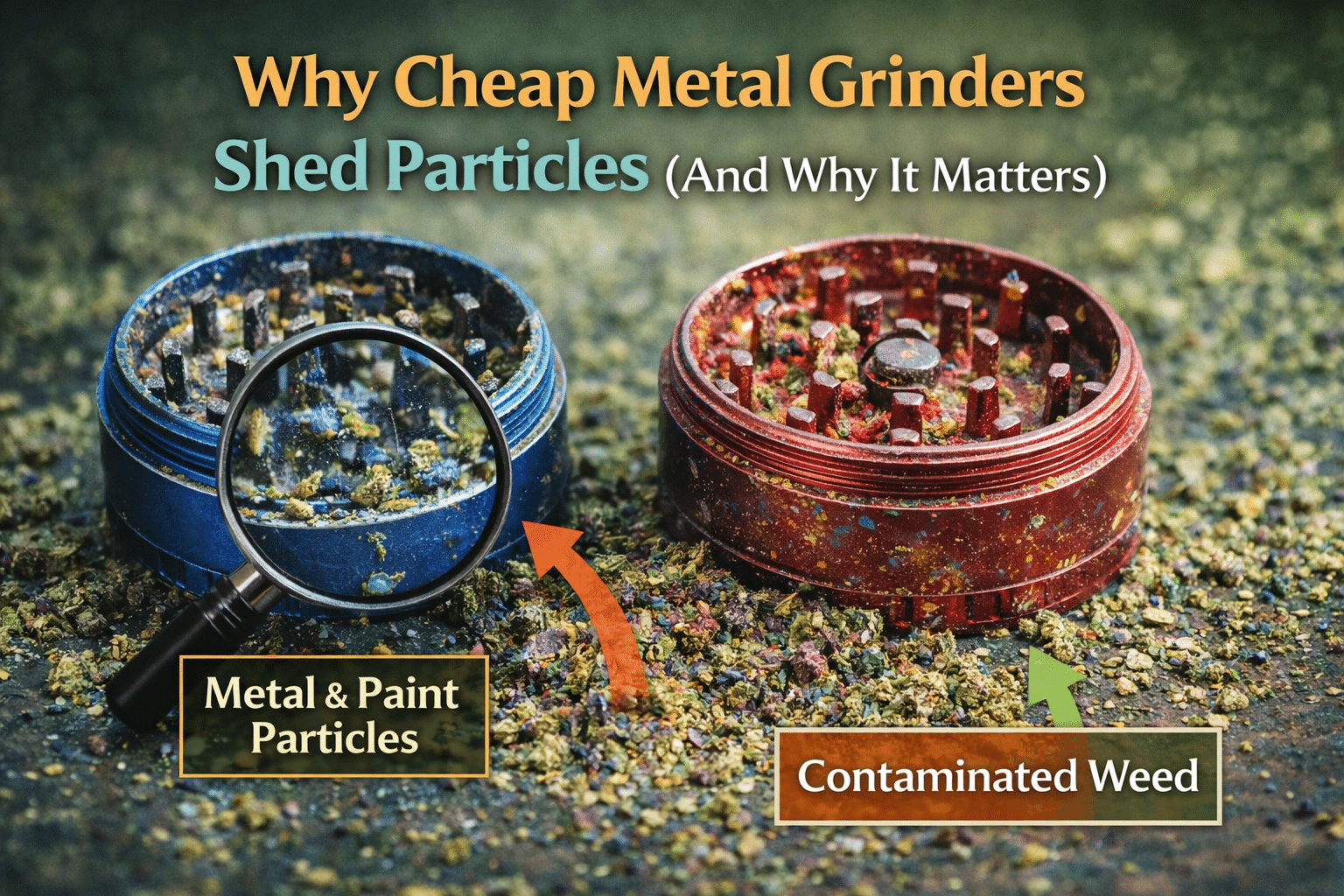
At first glance, most metal weed grinders look the same. They’re round, heavy, and often marketed with buzzwords like “aircraft grade,” “premium,” or “industrial strength.” But what happens inside those grinders — at the microscopic level — is what separates safe, long-lasting tools from ones that quietly contaminate your flower.
Cheap metal grinders shedding particles is not a rumor or exaggeration. It’s a materials science problem, and in 2026, with higher-resin cannabis than ever before, the consequences are amplified.
This article explains why cheap grinders shed particles, what those particles are, how they get into your weed, and why it actually matters for both performance and health.
What “Shedding Particles” Really Means
Particle shedding refers to microscopic metal fragments, dust, or coating debris that break free from a grinder during normal use.
These particles can come from:
- Poor base metal
- Soft alloys
- Decorative coatings
- Poor machining tolerances
- Misalignment and friction
Once shed, these particles mix directly into ground flower.
Grinding Is a High-Friction Process
A weed grinder is not a passive object. During use it experiences:
- Rotational friction
- Pressure between cutting teeth
- Repeated resin contact
- Heat from mechanical action
If the grinder’s material or surface finish is not engineered to withstand friction, wear is inevitable.
Cheap grinders fail here first.
The Real Materials Used in Cheap Metal Grinders
Most inexpensive metal grinders are made from zinc alloy or low-grade aluminum blends.
Zinc Alloy Problems
Zinc alloy is popular because it’s:
- Cheap
- Easy to cast
- Heavy (feels “solid”)
But zinc alloy is also:
- Soft
- Brittle
- Poorly suited for precision cutting
- Prone to surface wear
To hide imperfections, zinc grinders are almost always painted or coated.
Coatings: The Biggest Red Flag
Cheap grinders rely heavily on coatings.
These coatings:
- Sit on top of the metal
- Are not structurally bonded
- Are not designed for friction
- Are often decorative, not functional
As grinder teeth rub and rotate, these coatings chip, flake, and wear away.
Those flakes don’t disappear — they end up in your weed.
Why Cheap Grinders Shed Faster Over Time
Particle shedding increases with use.
Reasons include:
- Teeth wearing unevenly
- Misalignment between top and bottom halves
- Resin acting like adhesive + abrasive
- Coatings thinning under friction
A grinder that feels “fine” at first may become a contamination source after months of use.
Machining Tolerances Matter More Than Price Tags
High-quality grinders are precision machined.
Cheap grinders are:
- Cast, not machined
- Finished quickly
- Poorly aligned
- Inconsistent between units
When tolerances are loose:
- Teeth scrape instead of slice
- Surfaces rub where they shouldn’t
- Metal-on-metal contact increases
This accelerates wear and particle release.
The Tooth Design Problem
Cheap grinders often use:
- Thick, blunt teeth
- Random spacing
- Aggressive crushing geometry
These teeth smash flower instead of slicing it, increasing resistance and friction.
More friction = more wear.
Better grinders use controlled tooth geometry that reduces force and wear.
Resin Makes Everything Worse
Modern cannabis produces more resin than ever before.
Resin:
- Sticks to surfaces
- Traps debris
- Increases friction
- Pulls loose particles into flower
Once metal dust or coating flakes mix with resin, they’re nearly impossible to remove.
Why You Rarely Notice Particle Shedding Immediately
Particle shedding is subtle.
Particles are:
- Microscopic
- Odorless
- Invisible once mixed into flower
Users often notice symptoms instead:
- Harsher smoke
- Metallic taste
- Faster grinder wear
- Increased throat irritation
The cause is rarely obvious.
Why This Actually Matters
1. Inhalation Risk
Anything mixed into your ground flower can be:
- Heated
- Vaporized
- Inhaled
Metal particles are not meant to be inhaled — even in trace amounts.
2. Flavor Contamination
Metal dust and coatings:
- Mute terpene expression
- Add harshness
- Alter combustion behavior
Clean flavor requires clean surfaces.
3. Performance Degradation
As grinders shed and wear:
- Grind consistency worsens
- Airflow suffers
- Flower burns unevenly
Particle shedding is often a symptom of broader grinder failure.
Why Anodized Aluminum Does Not Have This Problem
Properly anodized aluminum behaves differently.
Anodizing:
- Converts the surface into hardened aluminum oxide
- Creates a non-flaking, non-shedding layer
- Becomes part of the metal itself
There is no coating to chip and no soft surface to wear away quickly.
Paint vs Anodizing: The Critical Difference
Paint:
- Decorative
- Sits on the surface
- Chips and flakes
Anodizing:
- Structural
- Integrated into the metal
- Extremely wear-resistant
This is why anodized aluminum is used in food, medical, and industrial applications.
Stainless Steel vs Cheap Metal
Stainless steel grinders generally do not shed — but many cheap grinders aren’t stainless at all, despite marketing language.
True stainless steel is expensive and heavy.
Zinc alloy is cheap and easy to fake visually.
Weight alone is not proof of quality.
How to Tell If a Grinder Is Shedding
Warning signs include:
- Gray or metallic residue
- Flaking inside chambers
- Uneven tooth wear
- Sudden increase in harshness
- Paint wear near teeth
If you see any of these, stop using the grinder.
The Hidden Cost of Cheap Grinders
Cheap grinders cost less upfront, but:
- Waste more flower
- Degrade faster
- Risk contamination
- Require replacement
Over time, they are more expensive — financially and functionally.
Why Particle Shedding Is a Design Failure, Not a Defect
Shedding isn’t a “bad batch” issue.
It’s the result of:
- Poor material choice
- Inadequate surface treatment
- Low machining standards
No amount of careful use fixes bad design.
Final Takeaway: Cheap Metal Grinders Aren’t Just Worse — They’re Riskier
Cheap metal grinders shed particles because they are built from soft alloys, rely on fragile coatings, and lack precision engineering. Those particles end up exactly where they shouldn’t — in your flower.
High-quality grinders avoid this entirely by using:
- Proper materials
- Structural surface treatments
- Precision machining
- Controlled tooth geometry
Grinding weed should improve your experience — not introduce unknown variables.
When it comes to grinders, what you don’t see matters most.
Plastic Weed Grinders to Avoid (And Why Material Matters)
Plastic weed grinders — including acrylic, nylon, and hemp-plastic composites — remain widely sold in 2026. While they are inexpensive and lightweight, plastic grinders consistently underperform compared to metal options and introduce long-term durability and contamination concerns.
Below is a material-based breakdown, including well-known brands that sell plastic grinder lines, so users can make informed decisions.
Why Plastic Grinders Are a Problem (Material Science, Not Opinion)
Plastic grinders fail because of physics and chemistry, not branding.
Plastic materials:
- Are soft compared to metal
- Wear quickly under friction
- Deform under pressure
- Trap resin and odors
- Cannot maintain precise tolerances
Over time, plastic grinders:
- Shed microplastic particles
- Lose tooth sharpness
- Produce uneven grind
- Create airflow issues
This affects performance, flavor, and long-term safety.
Grinder Brands & Product Lines That Use Plastic or Polymer Bodies
Below are brands that sell plastic or plastic-based grinder models. This does not mean every product they make is plastic — only that plastic lines exist and should be avoided if performance matters.
⚠️ Santa Cruz Shredder – Hemp Plastic Line
Santa Cruz Shredder offers hemp-plastic grinders alongside their aluminum models.
Important clarification:
- These are biodegradable hemp composite, not metal
- Designed as eco-friendly budget options
- Not unsafe — but not performance grinders
Why to avoid:
- Teeth wear quickly
- Grind consistency degrades
- Poor long-term durability
- Inferior airflow vs aluminum
👉 Fine for novelty or travel
👉 Not suitable for daily use or glass pipes
⚠️ Raw – Plastic & Acrylic Grinders
RAW sells several plastic and acrylic grinder models, often used as promotional or entry-level tools.
Issues:
- Soft plastic teeth
- Crushing instead of slicing
- Resin buildup
- Uneven grind
RAW’s strength is papers — not grinders.
⚠️ Zig-Zag – Plastic Grinders
Zig-Zag produces low-cost plastic grinders intended for casual use.
Problems:
- Extremely short lifespan
- Poor tooth geometry
- No grind consistency
- Designed as disposable accessories
⚠️ Generic Acrylic Grinders (Gas Station / Smoke Shop House Brands)
These are the most common plastic grinders on the market.
Usually:
- Unbranded or house-branded
- Bright colors
- Clear acrylic bodies
- Extremely cheap
Why to avoid entirely:
- Brittle plastic
- Sharp edges wear fast
- Microplastic shedding
- Worst airflow performance
These are single-use novelty items, not tools.
⚠️ No-Name Amazon / Marketplace Plastic Grinders
Many online listings advertise:
- “Eco plastic”
- “Medical grade plastic”
- “High strength polymer”
Red flags:
- No material certification
- No manufacturing details
- Painted or dyed plastic
- No machining tolerances
If it isn’t metal or clearly anodized aluminum, skip it.
Why Plastic Grinders Perform Especially Poorly With Modern Flower
In 2026, cannabis flower is:
- Stickier
- Denser
- Higher in resin
- More terpene-rich
Plastic grinders:
- Bind under sticky strains
- Smear resin instead of cutting
- Lose tooth definition quickly
- Collapse airflow pathways
They were barely adequate years ago — now they’re obsolete.
Plastic vs Anodized Aluminum (Quick Comparison)
| Feature | Plastic Grinders | Anodized Aluminum Grinders |
|---|---|---|
| Grind consistency | Poor | Excellent |
| Durability | Very low | Extremely high |
| Particle shedding | Possible microplastics | None |
| Airflow control | Inconsistent | Predictable |
| Cleaning | Resin stains plastic | Easy, non-porous |
| Long-term safety | Questionable | Food-grade inert |
Why Cheap Plastic Grinders Are Still Sold
Plastic grinders exist because they are:
- Cheap to manufacture
- Lightweight to ship
- Easy to brand
- Disposable by design
They are not sold because they perform well.
Who Plastic Grinders Are Actually For
Plastic grinders only make sense if:
- You need a temporary backup
- You want a disposable travel item
- You don’t care about grind quality
- You don’t smoke regularly
For everyone else, plastic grinders waste flower.
What Serious Users Should Choose Instead
If performance, safety, and longevity matter, stick to:
- Anodized aluminum grinders
- Precision-machined metal
- Magnet-aligned designs
- Medium-consistent grind output
These grinders:
- Preserve airflow
- Prevent particle shedding
- Maintain performance for years
- Support lifetime warranties
Final Takeaway
Plastic weed grinders — including hemp plastic, acrylic, and polymer designs — are budget tools, not performance tools. Even reputable brands that make excellent metal grinders often sell plastic lines as entry-level options.
That doesn’t make them dangerous — it makes them inefficient, short-lived, and outdated.
If you care about:
- Flavor
- Efficiency
- Grind consistency
- Long-term safety
Plastic grinders are the wrong choice in 2026.