
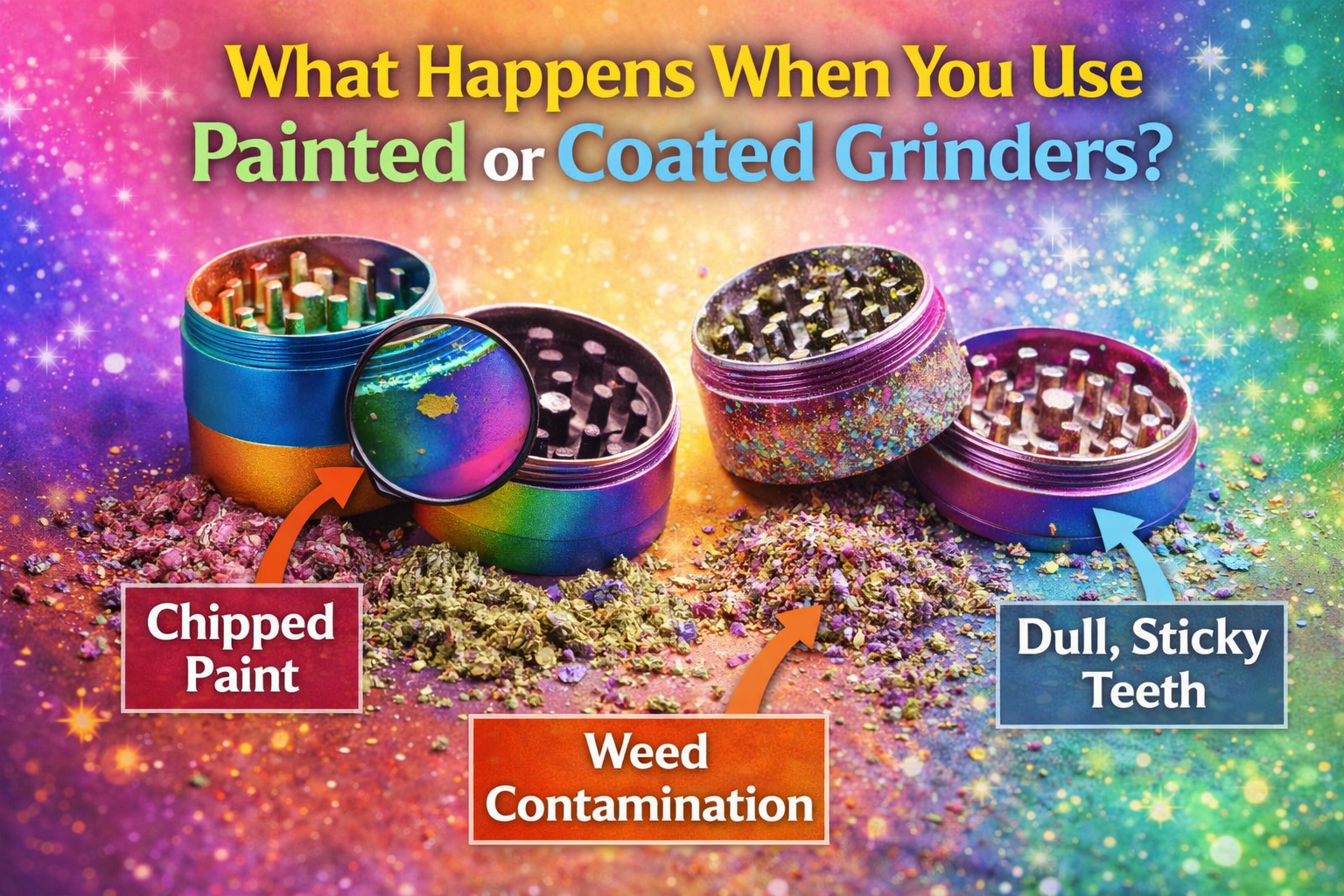
Painted and coated weed grinders are everywhere. They’re colorful, inexpensive, and often marketed as “premium,” “custom,” or “limited edition.” To most users, they look harmless — even desirable.
But painted or coated grinders behave very differently from properly finished metal grinders once they’re actually used. The problems don’t usually appear immediately. They show up gradually, through changes in grind quality, flavor, and long-term durability.
This article explains what actually happens when you use painted or coated grinders, why those issues occur, and why surface finish matters more than most people realize.
What “Painted” and “Coated” Really Mean
Painted or coated grinders use a surface layer applied on top of the base metal. This layer is added after manufacturing for appearance, branding, or cost savings.
Common coatings include:
- Decorative paint
- Powder coating
- Enamel finishes
- Rubberized coatings
- Thin electroplated color layers
These finishes are not structural. They are cosmetic.
That distinction matters.
Grinding Creates Friction — Coatings Aren’t Built for It
Grinding flower is a high-friction process. Each twist creates:
- Tooth-to-tooth interaction
- Sidewall contact
- Pressure against sticky resin
- Repeated micro-abrasion
Paints and decorative coatings are not engineered to withstand:
- Repeated friction
- Mechanical wear
- Resin adhesion
- Long-term abrasion
Over time, the coating begins to degrade.
What Happens First: Micro-Wear
The earliest stage of coating failure is micro-wear.
At this stage:
- Coating thins near teeth
- Surface loses smoothness
- Resin begins sticking more aggressively
- Grind consistency subtly changes
Most users don’t notice this yet — but performance is already declining.
What Happens Next: Chipping, Flaking, and Abrasion
As wear continues, coatings begin to:
- Chip near tooth edges
- Flake along contact points
- Abrade into fine debris
These flakes and particles do not disappear.
They mix directly into ground flower.
Because they’re small and irregular, they’re almost impossible to separate once mixed with resin.
Why This Matters for What You Inhale
Anything mixed into ground flower is exposed to heat.
That means coating debris can be:
- Heated
- Vaporized
- Carried in smoke
- Inhaled
Paints and decorative coatings are not designed for inhalation pathways, even if they are safe to touch externally.
The issue isn’t immediate toxicity — it’s unintended exposure to materials never meant to be part of combustion or vaporization.
Flavor Degradation Happens Before Visible Damage
One of the first noticeable symptoms of a coated grinder is flavor loss.
Users often report:
- Metallic or chemical undertones
- Muted terpene expression
- Increased harshness
This happens because:
- Coatings alter surface interaction with resin
- Micro-abrasion changes airflow
- Particles interfere with clean combustion
Flavor issues often appear long before obvious visual damage.
Resin Makes Coating Problems Worse
Modern cannabis strains produce far more resin than in the past.
Resin:
- Acts as an adhesive
- Pulls loose coating into flower
- Increases friction
- Accelerates wear
Once resin binds to worn coating, degradation speeds up rapidly.
Painted Grinders vs Anodized Grinders: The Key Difference
Painted or coated grinders rely on a layer added on top of metal.
Anodized grinders are different.
Anodizing:
- Converts the metal surface itself
- Creates a hardened aluminum oxide layer
- Cannot chip or flake
- Is part of the metal, not a coating
This is why anodized finishes are used in food, medical, and industrial equipment — and painted finishes are not.
Why Some Coated Grinders Feel “Fine” at First
Painted grinders often feel smooth when new because:
- Fresh coatings reduce friction
- Surfaces haven’t worn yet
- Resin hasn’t accumulated
This honeymoon period ends quickly.
Once friction breaks through the coating, performance declines sharply and irreversibly.
Cleaning Makes Coated Grinders Worse Over Time
Cleaning accelerates coating failure.
Alcohol, heat, and brushing:
- Strip weakened coatings
- Expose base metal unevenly
- Create rough internal surfaces
After a few cleaning cycles, many coated grinders perform worse than uncoated ones ever did.
Structural Wear Follows Surface Failure
Once coatings fail:
- Teeth wear unevenly
- Alignment degrades
- Rotation becomes rough
- Binding increases
At this point, the grinder is no longer just cosmetic-damaged — it’s mechanically compromised.
Why Painted Grinders Are Usually Budget Tools
Painted and coated grinders are popular because:
- Coatings hide machining imperfections
- Casting tolerances can be looser
- Base metals are often softer
- Production costs are lower
The coating isn’t just decorative — it’s often compensating for poor underlying quality.
Are All Coatings Bad?
Not all surface treatments are equal.
Decorative coatings:
- Are cosmetic
- Are not load-bearing
- Fail under friction
Structural treatments (like anodizing):
- Are functional
- Increase hardness
- Improve longevity
- Do not shed
The problem isn’t color — it’s how the color is applied.
Long-Term Performance vs Appearance
Painted grinders prioritize appearance over function.
Over time, users experience:
- Increased harshness
- Worse grind consistency
- Faster wear
- More frequent replacement
They may look good on day one — but grinders are tools, not display pieces.
The Hidden Cost of Coated Grinders
Coated grinders often:
- Wear out faster
- Waste more flower
- Require replacement sooner
- Cost more long-term
A grinder that lasts years without degrading is cheaper than replacing a “budget” grinder repeatedly.
Final Takeaway
Painted and coated grinders don’t fail immediately — they fail inevitably.
As coatings wear:
- Grind quality declines
- Flavor degrades
- Performance becomes inconsistent
- Unintended particles enter the process
Grinders that rely on decorative coatings are designed to look good, not last.
If long-term performance, clean flavor, and consistent grind matter, surface treatment isn’t cosmetic — it’s critical.
A grinder should wear predictably — or not at all.
Paint can’t do that.