
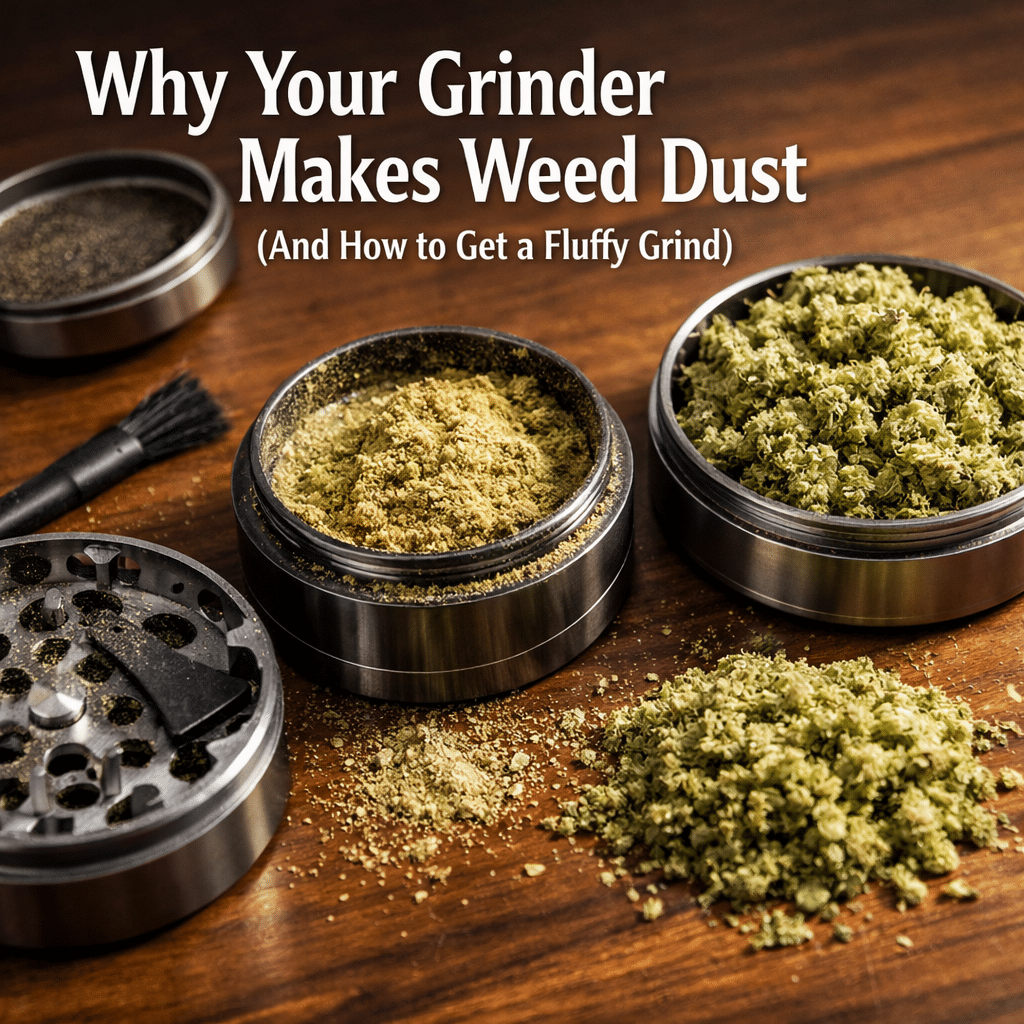
If your grinder turns perfectly good flower into dust, something is wrong — and it’s not the weed.
A dusty grind isn’t just annoying. It:
- Restricts airflow
- Burns too hot
- Wastes THC and terpenes
- Makes glass pipes harsh
- Causes joints to burn unevenly
In 2026, with cannabis flower being denser and more resin-rich than ever, grinders that produce dust instead of a fluffy grind are more common — and more problematic.
This guide explains why grinders make weed dust, what causes it mechanically, and exactly how to fix it so you get a light, fluffy, usable grind every time.
What “Weed Dust” Actually Is
Weed dust isn’t ground flower — it’s over-processed plant material.
Dust consists of:
- Pulverized trichome heads
- Shattered leaf matter
- Microscopic plant fibers
- Resin-coated powder
Once flower becomes dust, airflow collapses and combustion efficiency drops sharply.
A good grind should look aerated and textured, not sandy.
The Biggest Myth: “Finer Grind Is Better”
This myth refuses to die.
More grinding ≠ better grinding.
In reality:
- Excessively fine grind traps heat
- Restricts airflow
- Burns cannabinoids before inhalation
- Increases harshness
- Reduces total THC absorbed
Fluffy grind beats fine grind in nearly every smoking method except very specific vaporizer setups.
The Real Reasons Your Grinder Makes Weed Dust
1. Crushing Teeth Instead of Slicing Teeth
This is the #1 cause of dusty weed.
Crushing teeth:
- Smash flower under pressure
- Shatter trichomes
- Create powder mixed with chunks
Slicing teeth:
- Cut flower cleanly
- Preserve structure
- Maintain airflow
- Produce uniform particles
If your grinder relies on brute force instead of shearing motion, dust is inevitable.
2. Over-Grinding (User Error)
Even good grinders can make dust if misused.
Common mistakes:
- Twisting too many times
- Grinding aggressively
- Grinding past resistance
- Inverting the grinder repeatedly
Flower doesn’t need to be ground into submission.
Once resistance drops, stop.
3. Poor Surface Finish (Painted or Coated Grinders)
Painted or coated grinders degrade quickly.
As coatings wear:
- Surfaces become rough
- Flower catches and tears
- Resin binds to damage
- Dust production increases
In 2026, many “budget metal” grinders fail here.
4. Cheap or Soft Metals
Soft alloys:
- Deform under pressure
- Lose tooth definition
- Smash instead of cut
- Generate inconsistent output
Dust is often a sign that the grinder is wearing out, not just dirty.
5. Over-Dry Flower (But Not How You Think)
Very dry weed breaks apart easily — but it shouldn’t turn to dust if the grinder is good.
If dry flower instantly powders:
- Tooth geometry is wrong
- Grinder is over-aggressive
- Surfaces are rough
Good grinders still produce fluffy grind even with dry buds.
6. 4-Piece Grinder Over-Separation
Kief screens separate trichomes.
With aggressive grinding:
- Resin falls through early
- Remaining flower dries out
- Dust increases dramatically
This is why many glass-pipe users avoid heavy kief separation.
Why Weed Dust Is Bad for Smoking
Dust causes real performance issues.
Airflow Collapse
Fine particles compact tightly, blocking air.
Hot Combustion
Restricted airflow increases temperature, degrading THC.
Harsh Hits
Dust burns quickly and unevenly.
Flavor Loss
Terpenes vaporize too fast and burn off early.
What a Proper Fluffy Grind Looks Like
A fluffy grind is:
- Medium consistency
- Uniform particle size
- Light and springy
- Structurally intact
- Free-flowing
It should hold shape loosely, not collapse into powder.
How to Get a Fluffy Grind (Step by Step)
1. Use the Right Grinder Design
Look for:
- Precision slicing teeth
- Anodized aluminum construction
- Smooth internal surfaces
- Good alignment
Avoid:
- Painted coatings
- Plastic bodies
- Blunt or aggressive teeth
2. Don’t Overfill the Grinder
Flower needs room to move.
Overfilling causes:
- Compression
- Smearing
- Dust formation
Break large buds before grinding.
3. Grind Slowly and Intentionally
- Rotate smoothly
- Stop once resistance drops
- Don’t force extra turns
Grinding is not a speed contest.
4. Avoid Inverting Excessively
Flipping the grinder upside down encourages over-processing.
For fluffy grind, keep it upright.
5. Clean Before It Gets Bad
Resin buildup increases friction and tearing.
Light, regular cleaning prevents dust formation better than deep infrequent cleaning.
Grinder Size Matters
Very small grinders:
- Over-process quickly
- Compact flower
- Produce dust easily
Medium grinders (≈60–65mm):
- Provide better control
- Preserve structure
- Reduce over-grinding
Why Fluffy Grind Delivers Better Highs
Fluffy grind:
- Improves airflow
- Lowers combustion temperature
- Preserves cannabinoids
- Delivers smoother hits
- Maximizes THC absorption
Dusty grind feels harsh and inefficient by comparison.
When Dust Means Your Grinder Is Worn Out
If your grinder:
- Produces dust no matter what
- Feels rough even when clean
- Smears flower instead of cutting
- Has rounded teeth
It has reached the end of its performance lifespan.
No cleaning or technique will fix worn geometry.
Final Takeaway
Weed dust is not a sign of strong weed or good grinding.
It’s a sign of:
- Poor tooth geometry
- Over-aggressive grinding
- Degraded surfaces
- Or worn-out tools
A fluffy grind is the result of precision, restraint, and good design.
If your grinder is turning flower into dust, it’s time to stop blaming the weed — and start looking at the mechanics.
Better grind = better airflow
Better airflow = better highs
And fluff beats dust every time.