
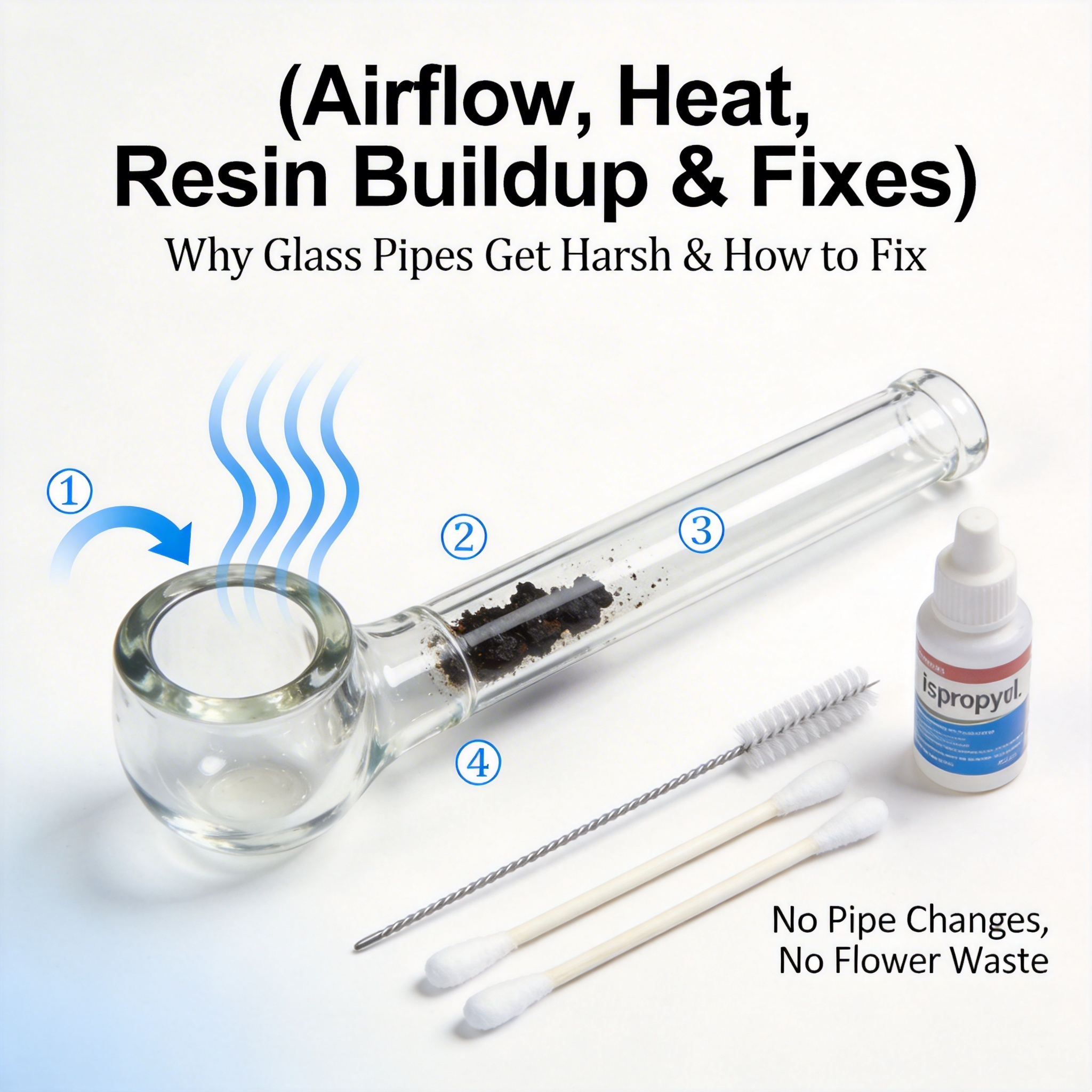
(Airflow, Heat, Resin Buildup & Fixes)
Glass pipes are loved for one reason: purity. No paper, no water chamber, no electronics—just direct flavor and immediate feedback. That purity is also why glass pipes can become harsh faster than any other smoking method.
When a glass pipe starts burning hot, tasting acrid, or hitting your throat hard, the problem is rarely “cheap glass” or “bad weed.” In almost every case, harshness comes from airflow restriction, excessive heat, resin buildup, or preparation errors.
This guide explains exactly why glass pipes get harsh, how to diagnose the cause, and what actually fixes it—without changing pipes or wasting flower.
What “Harsh” Really Means in a Glass Pipe
Harshness isn’t subjective. It’s physical.
A harsh hit happens when smoke:
- Is too hot
- Moves too fast
- Contains too many particulates
- Lacks sufficient airflow
Glass pipes don’t buffer any of these variables. If something is off, you feel it immediately.
The #1 Cause of Harsh Glass Pipes: Restricted Airflow
Airflow controls everything in a glass pipe.
When airflow is restricted:
- Combustion temperature spikes
- Smoke becomes hotter and denser
- THC degrades faster
- Terpenes burn instead of vaporizing
Restricted airflow turns smooth flower into throat burn.
What Restricts Airflow in Glass Pipes?
- Grind that’s too fine
- Overpacked bowls
- Resin narrowing the airway
- Ash buildup in the bowl
- Poor bowl-to-stem airflow design
Airflow is cumulative. Small restrictions add up fast.
Grind Size: The Silent Harshness Multiplier
The most common mistake with glass pipes is grinding too fine.
Fine grind:
- Compacts tightly
- Chokes airflow
- Burns hotter
- Produces harsher smoke
Glass pipes require a medium, fluffy, uniform grind—not powder.
If your pipe gets harsh halfway through a bowl, grind size is usually the culprit.
Overpacking the Bowl (Even With a Good Grind)
Even a perfect grind becomes harsh if packed too tightly.
Overpacking:
- Reduces oxygen flow
- Forces incomplete combustion
- Increases heat concentration
- Pulls ash into the airway
A properly packed bowl should:
- Allow visible air gaps
- Hold shape loosely
- Draw easily when unlit
If airflow feels tight before lighting, it will be harsh after.
Heat Management: Why Glass Pipes Burn Hotter
Glass pipes don’t dissipate heat the way water pipes do.
That means:
- Flame control matters
- Draw speed matters
- Bowl depth matters
Holding the flame too long or pulling too hard increases temperature faster than most users realize.
Signs Heat Is the Problem
- First hit is smooth, second hit is harsh
- Flavor drops quickly
- Smoke feels dry and sharp
- Bowl finishes too fast
This isn’t weak flower—it’s overheating.
Resin Buildup: The Gradual Harshness Trap
Resin doesn’t just affect smell—it reshapes airflow.
As resin accumulates:
- Airway diameter shrinks
- Smoke velocity increases
- Heat rises
- Harshness intensifies
Many users clean bowls but ignore stems and air channels, where most restriction actually happens.
How Resin Makes Pipes Harsh
Narrower airway = faster air = hotter smoke
Hotter smoke = more irritation
A pipe can look “mostly clean” and still hit terribly.
Ash and Carbon Buildup
Burnt carbon and ash create rough internal surfaces that:
- Trap heat
- Catch particulates
- Disrupt airflow
This causes scratchy, throat-heavy hits even with good flower.
If harshness increases mid-bowl, ash is blocking airflow.
Why Harshness Gets Worse Over Time
Glass pipes rarely get harsh overnight. It creeps in because:
- Resin hardens gradually
- Airflow degrades slowly
- Heat exposure increases incrementally
- Users unconsciously compensate by pulling harder
Pulling harder makes everything worse.
How to Diagnose the Exact Cause
Ask these questions:
- Does the pipe draw freely when empty?
- Is harshness worse mid-bowl than at the start?
- Does a fresh grind feel smoother than older ground flower?
- Does cleaning restore smoothness temporarily?
Your answers point directly to airflow, heat, or buildup issues.
Real Fixes That Actually Work
1. Fix the Grind
- Use a medium grind
- Avoid powder
- Stop grinding as soon as resistance drops
Fluffy structure = cooler smoke.
2. Pack Less, Not Tighter
- Fill bowls loosely
- Leave air gaps
- Avoid tamping down
Airflow matters more than capacity.
3. Control the Flame
- Don’t torch the bowl
- Light edges, not center
- Remove flame as soon as combustion starts
Less flame = better flavor + smoother hits.
4. Clean the Entire Airway
Clean:
- Bowl
- Stem
- Mouthpiece
- Carb hole
A clogged stem ruins even the best bowl.
5. Slow the Draw
Pulling harder:
- Increases heat
- Speeds combustion
- Harshens smoke
Slow, steady draws cool smoke naturally.
Why Some Glass Pipes Stay Smooth Longer
Well-designed pipes:
- Maintain consistent airway diameter
- Balance bowl depth
- Promote even airflow
- Reduce turbulence
But even the best pipe will turn harsh if airflow is ignored.
When Harshness Is NOT the Pipe’s Fault
It’s rarely the glass.
Harshness almost always comes from:
- Preparation errors
- Maintenance neglect
- Technique issues
Fix those first before blaming the pipe.
Long-Term Prevention Checklist
✔ Medium grind
✔ Loose pack
✔ Controlled flame
✔ Regular stem cleaning
✔ Gentle draw speed
✔ Avoid reheating ash
These prevent 90% of harshness issues.
Final Takeaway
Glass pipes don’t get harsh because they’re bad—they get harsh because they tell the truth.
They reveal:
- Poor airflow
- Excess heat
- Resin buildup
- Over-aggressive technique
Fix airflow first. Control heat second. Maintain cleanliness always.
When those variables are right, glass pipes deliver what they’re famous for:
clean flavor, smooth hits, and efficient highs—without the burn.
Harshness isn’t inevitable.
It’s mechanical—and entirely fixable.