
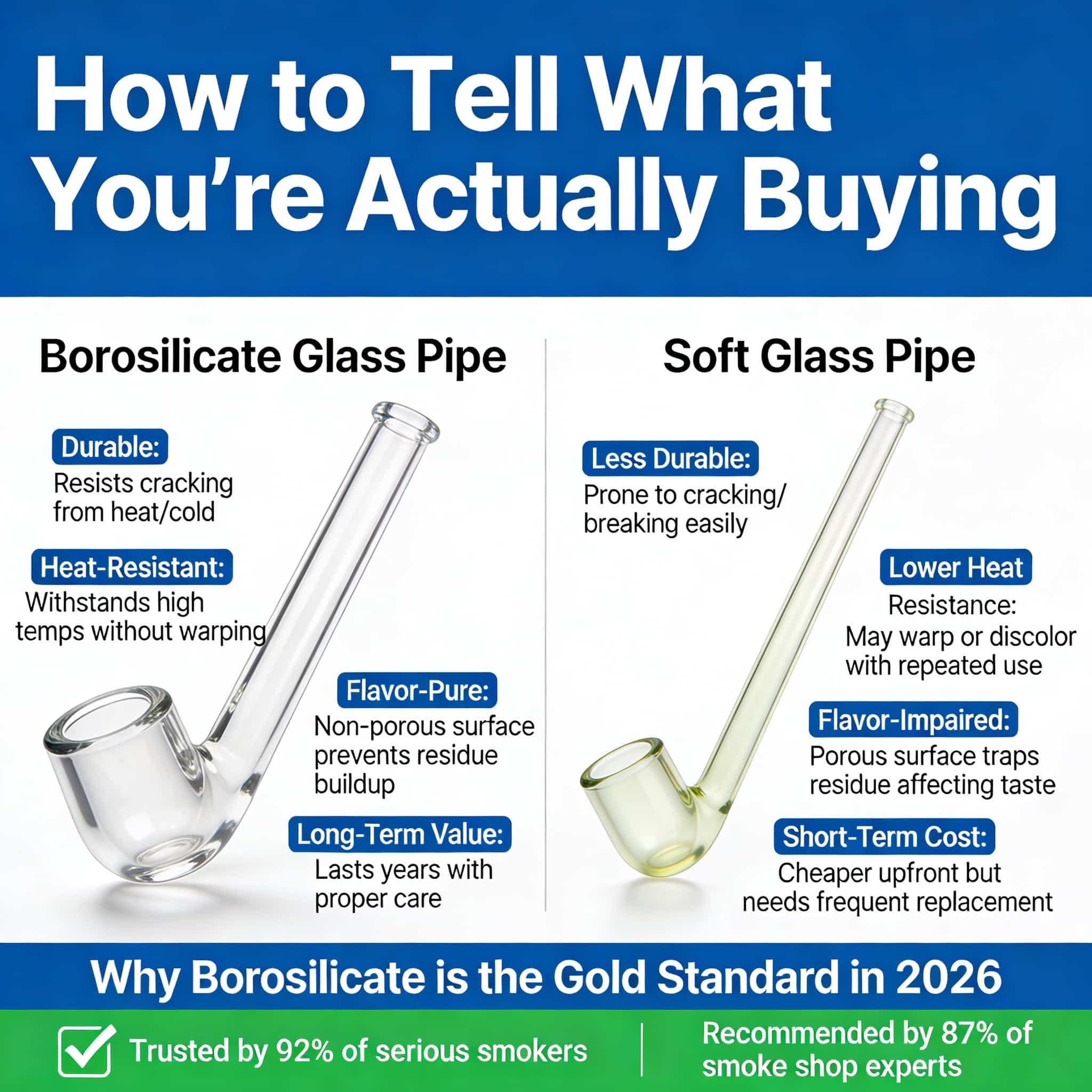
(How to Tell What You’re Actually Buying)
Not all glass pipes are created equal — and most shoppers don’t realize how big the difference is until something cracks, tastes off, or breaks far too easily.
In the smoking world, the terms “borosilicate glass” and “soft glass” get thrown around constantly, often without explanation. Sometimes “soft glass” isn’t even mentioned — it’s just implied by a low price or vague description.
If you care about durability, heat resistance, flavor purity, and long-term value, knowing the difference matters.
This guide breaks down borosilicate vs soft glass, how each behaves, how to spot the difference before you buy, and why borosilicate remains the gold standard in 2026.
What Borosilicate Glass Actually Is
Borosilicate glass is a specific glass formulation that includes boron oxide in addition to silica.
This composition gives borosilicate glass three critical properties:
- High heat resistance
- Low thermal expansion
- Increased structural stability
Borosilicate is used in:
- Laboratory glassware
- Medical equipment
- High-end cookware
- Scientific instruments
It’s not marketing — it’s chemistry.
What “Soft Glass” Really Means
“Soft glass” is not a technical term. It’s a catch-all phrase.
In most cases, soft glass refers to:
- Soda-lime glass
- Decorative glass blends
- Non-laboratory-grade formulations
This type of glass is commonly used for:
- Drinkware
- Decorative items
- Cheap glass products
Soft glass melts at lower temperatures and expands more when heated — two traits that are bad for smoking applications.
The Core Differences: Borosilicate vs Soft Glass
Heat Resistance
Borosilicate
- Handles repeated heating and cooling
- Resists thermal shock
- Stable under flame exposure
Soft Glass
- Sensitive to heat changes
- More likely to crack when hot
- Can fracture if cooled too quickly
Glass pipes experience constant thermal cycling. Borosilicate is built for it. Soft glass is not.
Thermal Expansion (Why Cracks Happen)
Thermal expansion is how much glass expands when heated.
- Borosilicate expands very little
- Soft glass expands much more
This is why soft glass can crack from:
- Repeated lighting
- Hot ash contact
- Rinsing with water after use
Borosilicate tolerates temperature swings without internal stress.
Durability and Longevity
Borosilicate
- More resistant to cracking
- Better impact tolerance
- Holds structure over time
Soft Glass
- Chips and fractures more easily
- Weakens faster with heat exposure
- Degrades with repeated use
Durability isn’t just thickness — it’s material behavior.
Flavor Purity
Borosilicate glass is:
- Chemically inert
- Non-porous
- Flavor-neutral
Soft glass:
- Can contain additives
- May retain odors
- Can slightly affect taste over time
If flavor matters to you, borosilicate is the safer choice.
Why Soft Glass Is Still Sold
Soft glass isn’t always bad — it’s just cheaper and easier to work with.
Manufacturers choose soft glass because:
- Lower production cost
- Easier shaping
- Faster manufacturing
- More decorative flexibility
This makes it popular for:
- Cheap novelty pipes
- Tourist shop glass
- Mass-produced imports
Price is usually the giveaway.
How to Tell If a Glass Pipe Is Borosilicate
1. Product Description Language
Look for:
- “Borosilicate glass”
- “Lab-grade glass”
- “Scientific glass”
- “3.3 glass” (common borosilicate rating)
If the listing just says “glass” — that’s a red flag.
2. Price Point (Reality Check)
Borosilicate costs more to produce.
If a pipe is:
- Extremely cheap
- Sold without material details
- Marketed only by appearance
It’s likely soft glass.
3. Weight and Density Feel
Borosilicate:
- Feels solid without being brittle
- Has a dense, balanced feel
Soft glass:
- Often feels lighter or more fragile
- Can feel “hollow” or thin
This isn’t foolproof — but it’s a clue.
4. Thickness Consistency
Borosilicate pieces usually have:
- Even wall thickness
- Smooth transitions
- Clean joints
Soft glass often shows:
- Inconsistent thickness
- Thin stress points
- Decorative over function designs
5. Resistance to Temperature Changes
This is not a test you should perform aggressively — but in normal use:
- Borosilicate handles repeated heating calmly
- Soft glass becomes hotter faster and cools unevenly
Soft glass feels “angrier” under heat.
Common Myths About Glass Types
“Thicker Glass Is Always Better”
Thickness helps, but material matters more. Thick soft glass can still crack.
“All Glass Is Basically the Same”
It isn’t. Composition changes behavior dramatically.
“If It Has Color, It’s Soft Glass”
False. Borosilicate can be colored and worked artistically.
Why Borosilicate Is Still the Gold Standard in 2026
Despite new materials and trends, borosilicate remains the preferred choice because it:
- Handles heat safely
- Preserves flavor
- Lasts longer
- Resists cracking
- Performs consistently
That’s why labs use it. That’s why serious smokers prefer it.
When Soft Glass Might Be Acceptable
Soft glass may be fine if:
- It’s a decorative piece
- It’s used infrequently
- It’s not exposed to heavy heat
- You accept higher breakage risk
For daily use? Borosilicate wins every time.
How Sellers Sometimes Obscure the Difference
Watch out for phrases like:
- “High-quality glass”
- “Premium glass”
- “Hand-blown glass” (without material)
- “Durable glass” (unspecified)
These terms mean nothing without material disclosure.
The Smart Buying Rule
If a seller doesn’t clearly state borosilicate, assume it’s not.
Reputable sellers are transparent because borosilicate is a selling point.
Final Takeaway
Borosilicate vs soft glass isn’t about hype — it’s about physics and chemistry.
Borosilicate:
- Resists heat
- Protects flavor
- Lasts longer
- Performs consistently
Soft glass:
- Is cheaper
- Is easier to decorate
- Is more fragile under heat
- Carries more risk
If you care about performance, durability, and value, borosilicate glass is the clear winner.
Knowing the difference lets you buy with confidence — and avoid paying for looks when you’re really paying for material.