
How Weed Grinders Are Made – Inside the Tahoe Grinder Company CNC Factory
At Tahoe Grinder Company, manufacturing isn’t outsourced, hidden, or automated overseas. Every premium weed grinder we produce begins as solid raw billet aluminum and is precision CNC machined inside our American factory using advanced equipment, experienced operators, and strict quality control standards.
Unlike mass-produced imported grinders, our products are engineered and manufactured using real machining processes that prioritize durability, performance, and dimensional accuracy. From the earliest stages of material preparation through final inspection and packaging, each step is carefully controlled to ensure consistent quality and long-term reliability.
This page takes you inside the real manufacturing process behind our high-performance herb grinders — from material selection and precision cutting to anodizing, assembly, and final delivery.
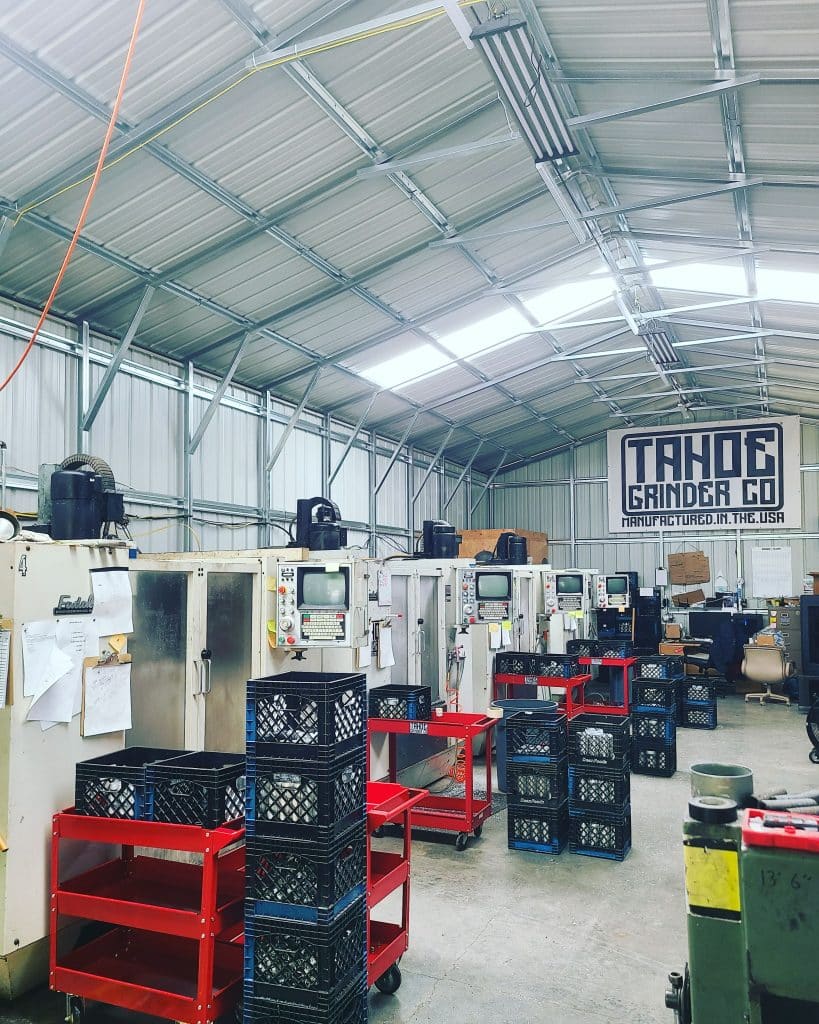
Pictured above is a production line of four Fadal VMC 2216 vertical machining centers, each equipped with high-torque 20-horsepower spindles and rapid travel speeds of up to 900 inches per minute. These American CNC machines allow Tahoe Grinder Company to maintain efficient, high-volume manufacturing while holding tight tolerances on critical grinder features.
In front of the machines, you can see multiple staging carts loaded with thousands of aluminum components in various stages of production. These parts move through a carefully planned workflow that includes cutting, machining, inspection, finishing, and assembly. This organized production environment allows our team to manufacture thousands of American-made weed grinders every day while maintaining strict process control and consistency.
Raw Material Selection – Billet Aluminum Bar Stock
Depending on the size of the weed grinder being manufactured, the raw material selected will closely match the finished diameter of the grinder component. For example, our popular 2.5-inch (63mm) American-made grinders begin as solid aluminum bar stock of similar diameter.
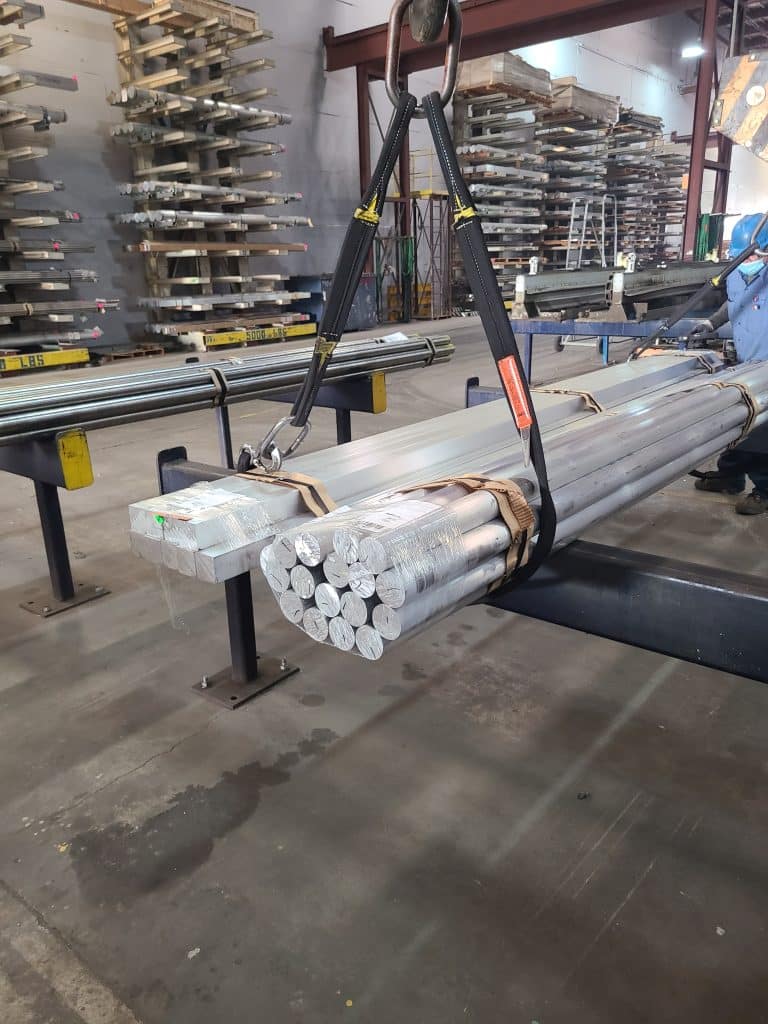
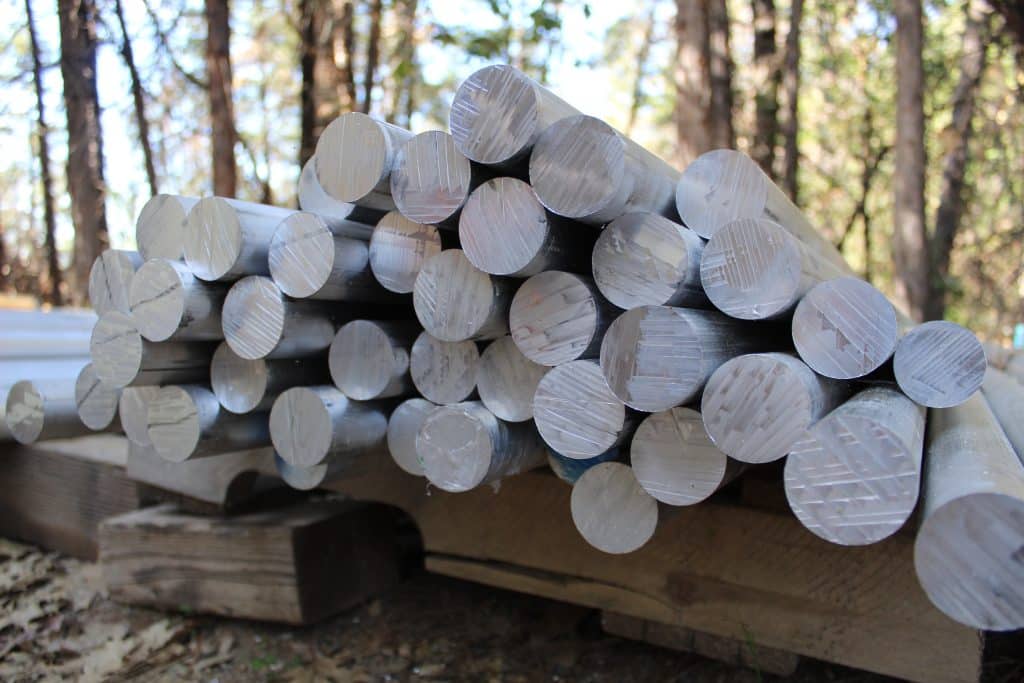
Pictured above: 2.5-inch billet aluminum bar stock prepared for CNC machining at the Tahoe Grinder Company factory.
Using near-net material sizing reduces waste, improves machining efficiency, and allows tighter control over dimensional accuracy. Every bar is inspected before entering production to ensure consistent alloy quality and structural integrity.
Automated Precision Cutting – CNC Controlled Hydmech H-12 Bandsaw
The aluminum bars are then cut into precise component blanks using a fully automated Hydmech CNC-controlled bandsaw. This critical early stage of production ensures that every grinder component begins with consistent material dimensions before entering the CNC machining process.
The bandsaw is programmed by a CNC shop operator to advance a highly specific cut length — for example, 1.060 inches per blank. This intentional over-sizing allows for precision facing operations on both sides of the component during CNC machining. After these machining operations are completed, the final grinder component thickness is held to an exact target of 1.000 inches.
Maintaining this additional machining allowance is an important part of high-tolerance manufacturing. It ensures that all grinder components achieve consistent flatness, parallelism, and dimensional accuracy — key factors that contribute to smooth grinder rotation, proper magnetic lid alignment, and long-term durability.
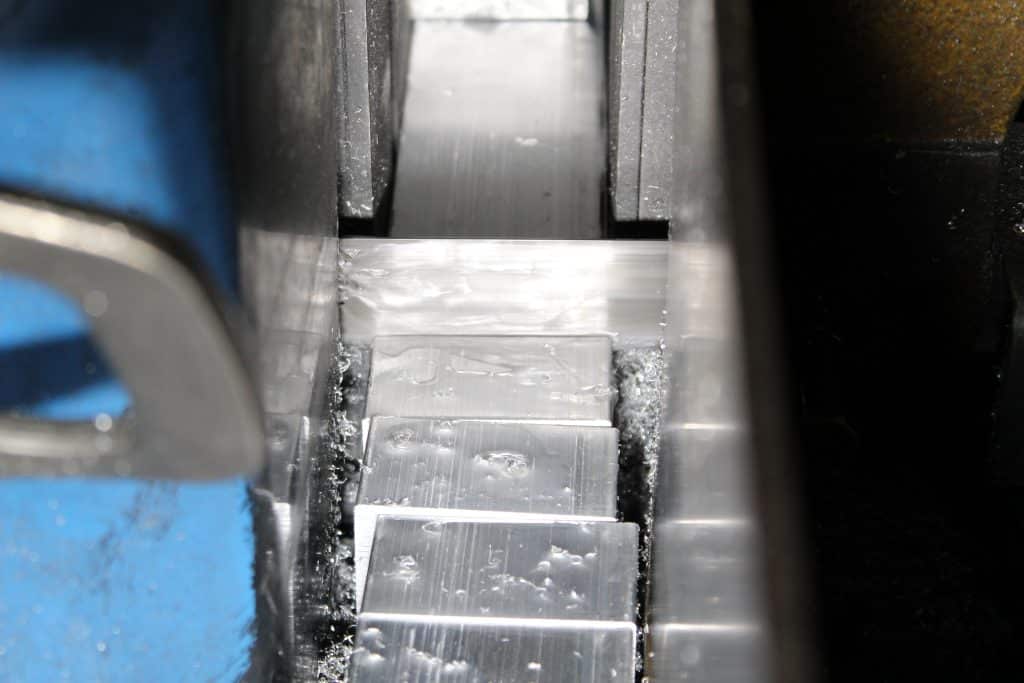
Pictured above: Aluminum billet bars being cut into precision blanks on the Hydmech CNC bandsaw.
Each cut is automatically controlled by the machine’s programmable feed system, allowing for repeatable accuracy across large production runs.
This level of planning and process control demonstrates the engineering mindset and precision manufacturing philosophy used throughout the Tahoe Grinder Company CNC facility. Every stage of production is designed to eliminate variability and maximize consistency.
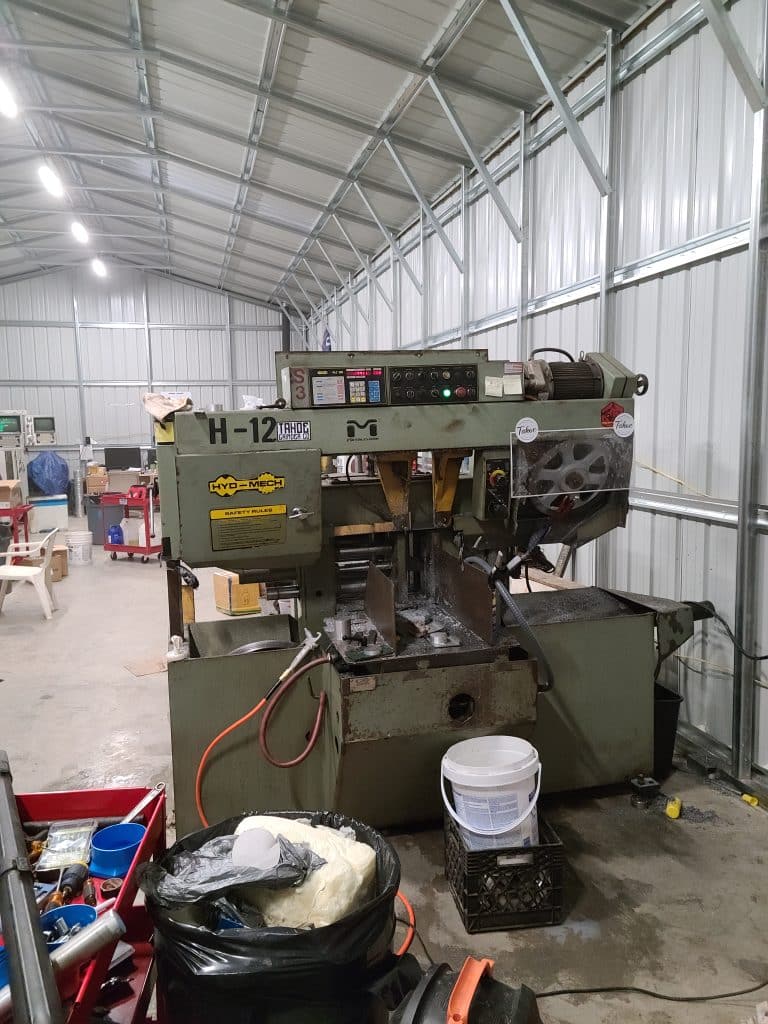
Also shown above is the Hydmech H12 automated bandsaw unit, a heavy-duty industrial cutting system used to prepare thousands of grinder components for machining. The automated nature of this equipment allows Tahoe Grinder Company to efficiently process raw aluminum stock while maintaining tight dimensional control before the parts enter CNC machining centers.
Fixture Machining – Multi-Part CNC Production
After cutting, the aluminum blanks are transferred to CNC machining centers where they are loaded into precision fixtures. A fixture is a specialized production tool designed to securely hold multiple components in exact alignment during machining operations. Proper fixturing is essential for achieving repeatable dimensional accuracy, consistent surface finishes, and efficient high-volume manufacturing.
For example, our popular 2.5-inch Puck® weed grinders are produced using a 21-part precision fixture. This allows a single CNC machine to manufacture multiple grinder components simultaneously within one machining cycle. Depending on the program and tool paths being executed, a single production run can continue for extended periods — sometimes up to two hours — without interruption.
This production strategy allows Tahoe Grinder Company to maintain both high manufacturing throughput and tight engineering tolerances, ensuring that every grinder performs consistently in real-world use.
Precision Fixture Setup Inside the CNC Machine
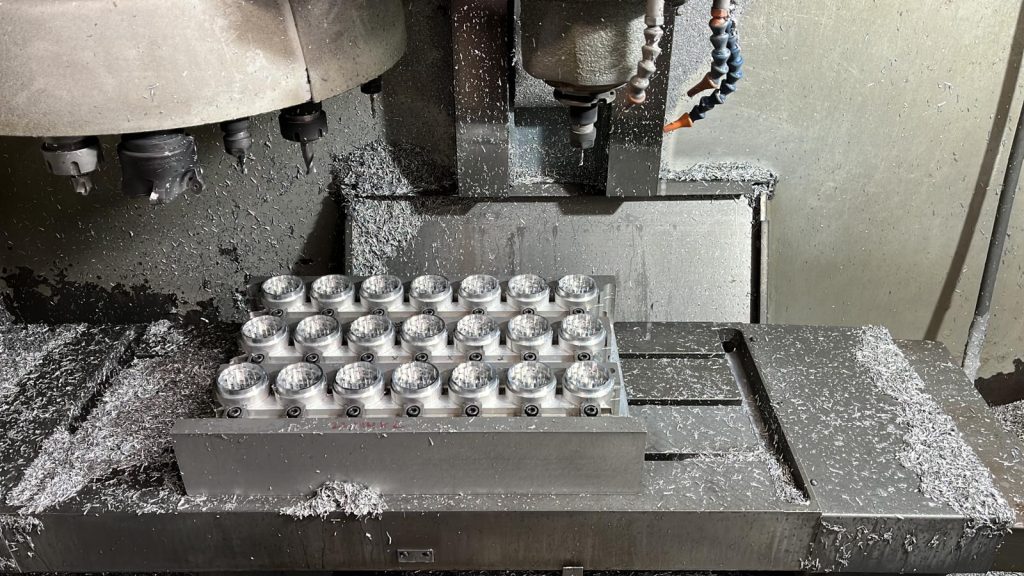
Pictured above: A 21-part production fixture loaded inside a vertical CNC machining center.
Each aluminum blank is positioned in a dedicated pocket within the fixture to ensure stable clamping and precise machining alignment. This setup allows the CNC machine to repeat the same complex machining operations across multiple parts with exceptional consistency.
Machining Grinder Teeth – End Mill in Operation
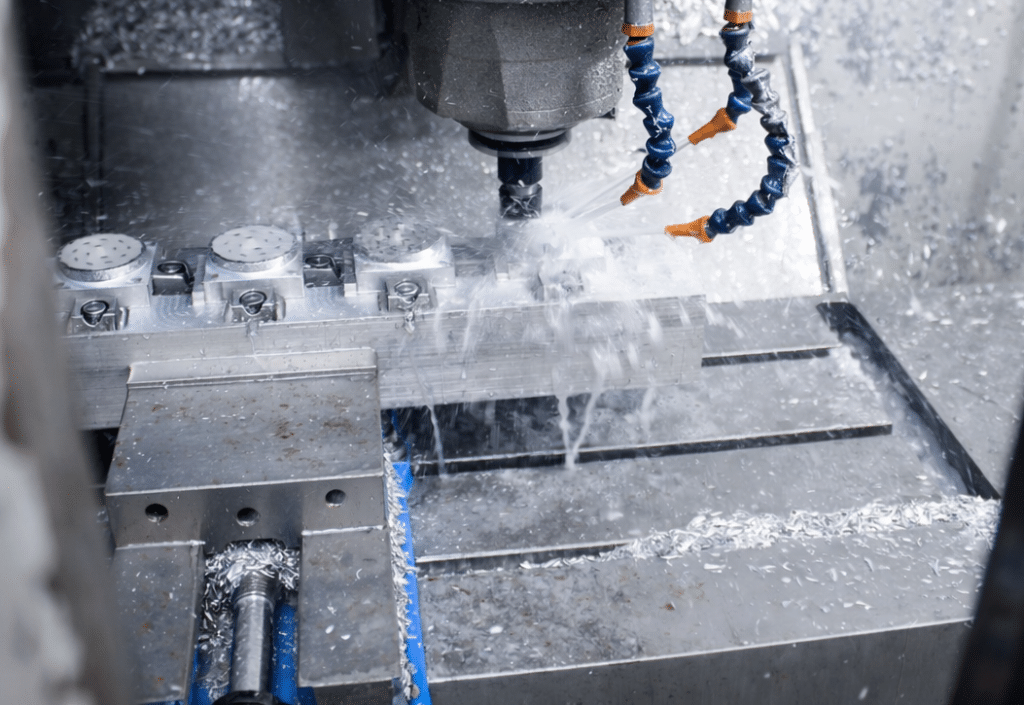
Pictured above: A carbide end mill actively machining the extended diamond-shaped grinding teeth inside multiple Puck® grinder components.
During this stage, advanced CNC toolpaths are used to create the tooth geometry responsible for producing a smooth, fluffy grind consistency. The precision of this operation directly affects grinder performance, material flow, and long-term durability.
High-Volume Production Environment – Chip Generation and Material Recycling
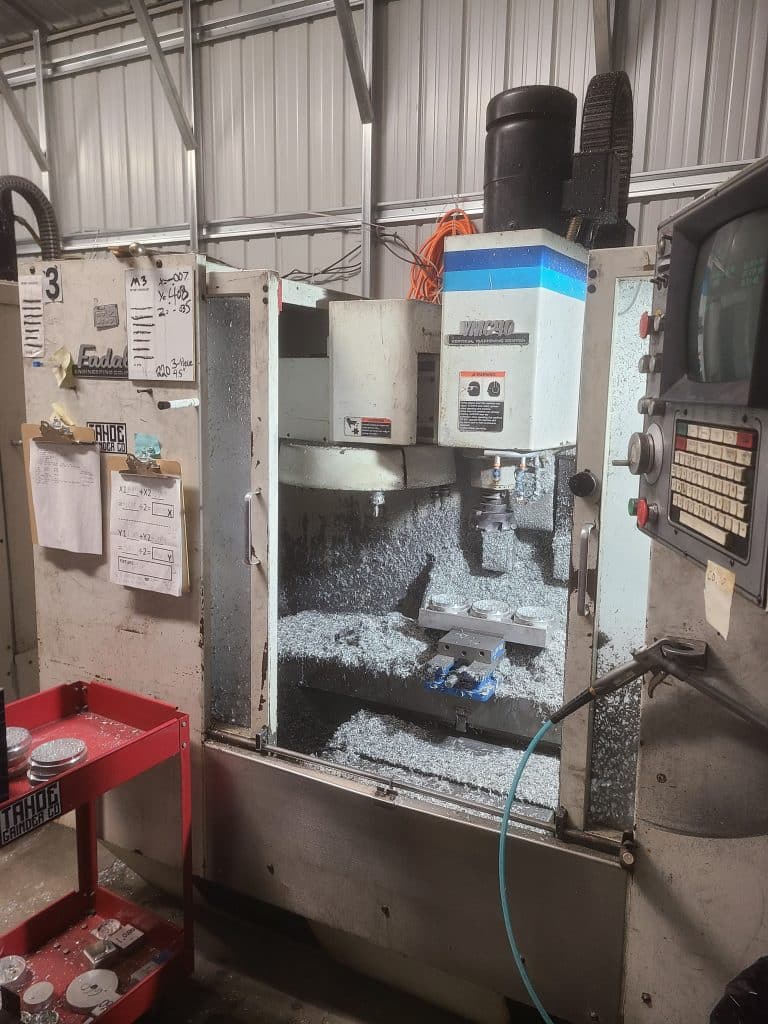
Pictured above: A wide view inside a vertical machining center with the machine doors open, revealing the loaded part fixture and accumulated aluminum chips generated during production.
Machining solid billet aluminum inevitably produces significant quantities of recyclable chips. These chips are collected and sent to metal recycling facilities, supporting efficient material use and responsible manufacturing practices.
Precision Facing Operation – Mirror Finish Surface Preparation
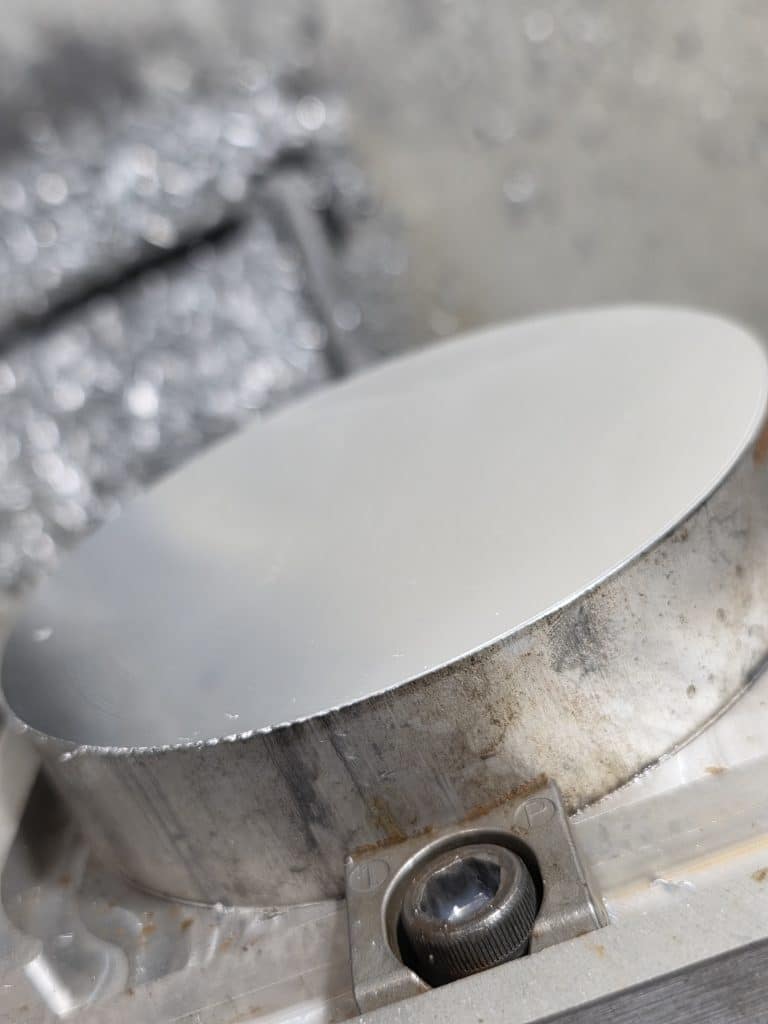
Pictured above: A close-up of a grinder component after a precision facing operation performed with a carbide-tipped face mill.
This machining process creates an extremely flat, smooth, mirror-like surface finish on the aluminum component. Proper facing ensures accurate component thickness, improved mating surface contact, and optimal rotational performance when the grinder is assembled.
Precision Facing in Action – Large Diameter Grinder Components
Video shown above: A 5-inch carbide-tipped face mill machining the top surface of 4.5-inch diameter grinder blanks inside a vertical CNC machining center.
During this operation, the large-diameter cutting tool sweeps across the aluminum surface, removing a controlled amount of material to achieve precise flatness and uniform thickness across the component.
This facing process is a critical step in high-tolerance manufacturing. By carefully controlling spindle speed, feed rate, and depth of cut, Tahoe Grinder Company ensures consistent surface finish quality while maintaining dimensional accuracy across production batches. The wide cutting path of the face mill allows the entire grinder surface to be machined in a single pass or series of overlapping passes, resulting in improved surface integrity and reduced tolerance stack-up during later assembly stages.
Beyond dimensional control, precision facing contributes to long-term grinder performance. Smooth, flat mating surfaces reduce friction during rotation, improve component alignment, and help maintain consistent grinding action over the lifetime of the product.
Because Tahoe Grinder Company operates multiple CNC machines simultaneously, different grinder models can be produced at the same time. This parallel manufacturing workflow allows us to produce thousands of American-made weed grinders per day while maintaining strict quality control standards.
By combining precision fixturing, advanced CNC programming, high-speed machining capabilities, and experienced operators, Tahoe Grinder Company delivers grinders that are engineered for long-term performance — not simply mass production.
Precision Machining – Tooth Geometry and Component Accuracy
One of the most critical stages in manufacturing a high-performance weed grinder is the precision machining of the grinding teeth and key functional features. At Tahoe Grinder Company, specialized carbide tooling and advanced CNC programming are used to create the extended diamond-shaped tooth geometry that defines the performance of our grinders.
These teeth are engineered to slice, shear, and break down material efficiently while promoting consistent particle size and optimal airflow through the grinding chamber. The result is a smooth, controlled grinding experience that produces a fluffy and uniform herb texture preferred by experienced users.
During this stage of production, multiple critical dimensions are tightly controlled, including:
- tooth width
- tooth height
- tooth spacing geometry
- screen seat depth
- lid interface tolerances
- thread engagement tolerances
- outer diameter
- component flatness and parallelism
Each of these dimensions plays an important role in grinder performance. Even small variations can affect grinding consistency, rotational smoothness, magnetic alignment, and long-term wear characteristics. For this reason, Tahoe Grinder Company utilizes high-precision CNC machining strategies combined with in-process inspection methods to maintain strict dimensional control throughout production.
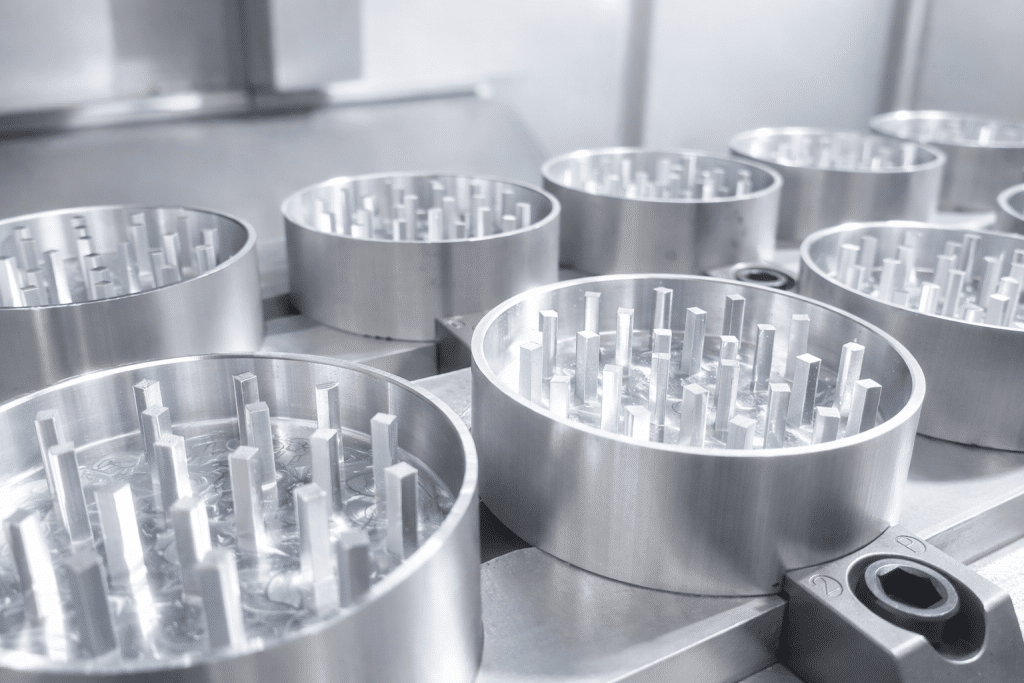
Pictured above: A close-up view of freshly machined grinder teeth prior to the deburring process.
At this stage, the precision geometry created by the CNC machining center can be clearly observed, showcasing the sharp, defined tooth profiles responsible for high-efficiency grinding performance.
Quality Control – Digital Measurement and Inspection
Following machining operations, every production batch moves through a structured quality control and inspection process. This step ensures that all grinder components meet Tahoe Grinder Company’s engineering specifications before proceeding to finishing and assembly stages.
Digital measuring tools capable of resolving down to 0.0005 inches (half of one thousandth of an inch) are used to verify key dimensions such as overall component thickness, outer diameter, tooth height consistency, and mating surface accuracy. For perspective, a single human hair is typically several thousandths of an inch thick, meaning these inspection tools allow technicians to measure tolerances far smaller than what is visible to the naked eye.
Maintaining this level of measurement precision is essential for ensuring that grinder components fit together properly, rotate smoothly, and deliver consistent performance over years of use. It also reflects the manufacturing discipline required to produce premium CNC-machined cannabis accessories at scale.
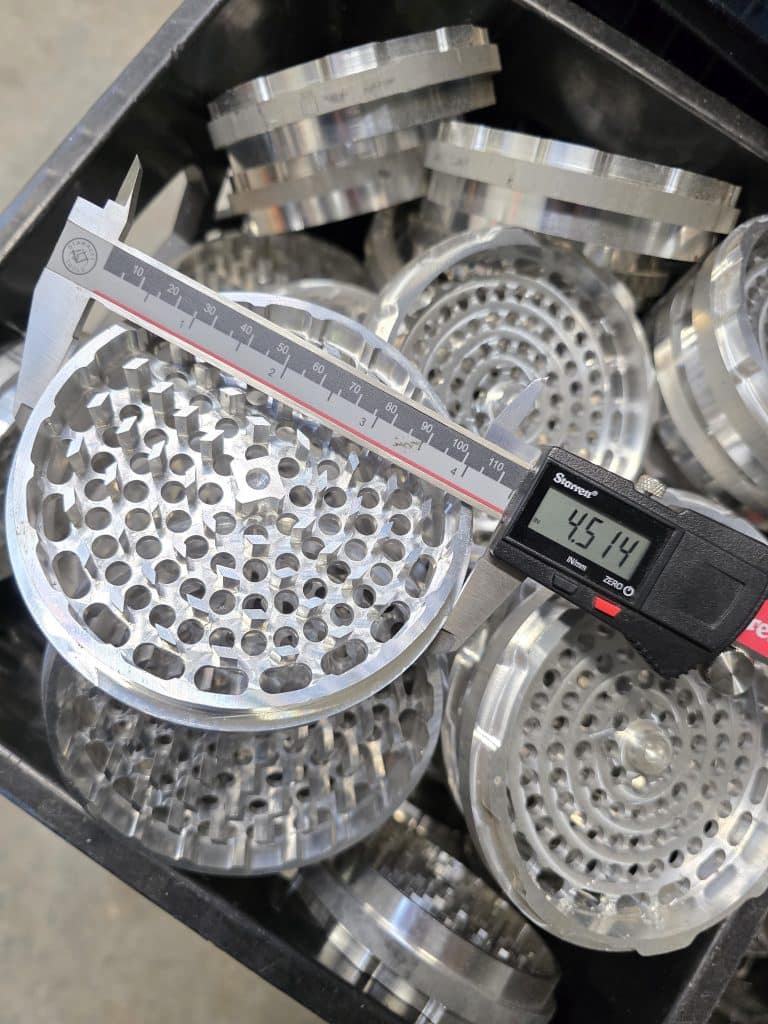
Pictured above: A grinder component being inspected with a Starrett® digital calipers to verify overall diameter and dimensional accuracy.
This inspection stage helps confirm that each part meets Tahoe Grinder Company’s quality standards before entering automated deburring, anodizing, and final assembly processes.
By combining advanced machining technology with rigorous quality inspection procedures, Tahoe Grinder Company ensures that every grinder leaving the factory represents a balance of precision engineering, durability, and long-term reliability.
Automated Deburring and Surface Preparation
After precision CNC machining and dimensional inspection, grinder components move into the surface finishing stage — a critical step that prepares each part for final coating and assembly. Although CNC machining produces highly accurate geometries, microscopic burrs, sharp edges, and residual metal fragments are a natural byproduct of cutting solid billet aluminum at high speeds.
To refine these machined surfaces and prepare them for the next stage of production, Tahoe Grinder Company utilizes a production-grade vibratory deburring system — the Mr. Deburr DB600, manufactured by C&M Topline, an American industrial equipment company based in Southern California. Supporting domestic manufacturing partners is an important part of our operational philosophy, and investing in high-quality American-made finishing equipment allows us to maintain consistent product standards while strengthening the local manufacturing ecosystem.
The Mr. Deburr DB600 is a high-capacity vibratory finishing machine designed for continuous industrial use. Large batches of grinder components can be processed simultaneously inside the machine, allowing for efficient and repeatable surface refinement across thousands of parts. This ensures that each grinder component receives the same level of finishing attention regardless of production volume.
Inside the deburring system, components are combined with specially engineered abrasive media — often tetrahedral or pyramid-shaped — selected specifically for their ability to reach intricate tooth geometries, internal pockets, and fine surface features. As the machine vibrates and rotates, the media gently abrades the aluminum surfaces, removing sharp corners, machining marks, and loose metal particles generated during the cutting process.
Video shown above: Grinder components moving through the Mr. Deburr DB600 vibratory finishing system while tetrahedral media actively smooths edges and refines surface texture.
This continuous motion ensures that the abrasive media makes consistent contact with all exposed surfaces, creating uniform edge rounding, improved tactile quality, and enhanced visual consistency.
Beyond improving appearance, deburring plays an essential functional role in grinder performance and long-term durability. Removing sharp edges and microscopic fracture points helps reduce wear over time, improves component fitment during assembly, and promotes smoother rotational interaction between mating parts. This finishing process also contributes to improved user comfort during handling and daily use.
Equally important, the deburring stage prepares the aluminum surface for professional anodizing. Proper surface conditioning is required to achieve uniform coating adhesion, consistent color finish, and long-lasting corrosion resistance. Any remaining machining debris or inconsistent surface texture could negatively affect coating quality, which is why Tahoe Grinder Company maintains strict finishing protocols before components leave the factory.
By using industrial-grade finishing equipment like the Mr. Deburr DB600, Tahoe Grinder Company is able to bring each grinder component closer to its final refined state before anodizing. The result is a clean, smooth, and precision-prepared surface that supports both premium aesthetics and long-term performance — key characteristics that define a high-quality American-made weed grinder.
Professional Anodizing – Durable American Coating
After surface preparation, grinder components are sent out for professional anodizing — a critical step that transforms raw machined aluminum into a durable, corrosion-resistant, and visually refined finished product.
Anodizing is an electrochemical process that converts the outer surface of aluminum into a controlled oxide layer. Unlike paint or surface coatings that sit on top of the material, anodizing becomes an integral part of the aluminum itself. This results in a finish that will not peel, chip, or flake under normal use.
Through this process, Tahoe Grinder Company grinders receive a high-performance protective layer that provides:
- durable color finishes
- enhanced scratch resistance
- fade resistance over time
- corrosion protection
- improved surface hardness
- clean, food-safe internal surfaces
The anodized layer also creates a uniform and consistent base for laser engraving, allowing designs and branding elements to appear crisp, high-contrast, and long-lasting.
From both a performance and aesthetic standpoint, anodizing plays a vital role in the overall quality of the grinder. The increased surface hardness helps protect against wear from repeated use, while the corrosion-resistant properties ensure that the grinder maintains its appearance and functionality even in demanding environments.
Equally important, proper anodizing contributes to the smooth interaction between mating components. When combined with precision machining and deburring, the anodized finish helps maintain consistent tolerances and reduces long-term degradation of critical surfaces.
This professional finishing process is a key reason Tahoe Grinder Company grinders are built for long-term use rather than short-term replacement. By integrating precision machining with advanced surface treatment, we create grinders that are not only visually striking but also engineered to withstand years of continuous operation.
Magnet Installation – High Strength Rare Earth Neodymium Magnets
Once anodized grinder components return to the Tahoe Grinder Company CNC facility, the assembly process begins. At this stage, each component has already undergone precision machining, surface finishing, and professional anodized coating. The next step focuses on functional hardware installation — starting with the magnetic lid retention system.
Every Tahoe Grinder Company weed grinder is equipped with a 6mm diameter N52-grade rare earth neodymium magnet, one of the strongest commercially available magnet grades used in precision consumer products. Magnet grading refers to the maximum magnetic energy product of the material, which directly influences pull strength and holding performance. By selecting N52 magnets, Tahoe Grinder Company ensures exceptional lid retention, reliable alignment, and consistent user experience during repeated opening and closing cycles.
These magnets are installed with careful attention to polarity orientation and seating depth. Proper magnet installation is critical for maintaining long-term performance, preventing unwanted lid separation, and ensuring smooth rotational alignment between grinder sections.
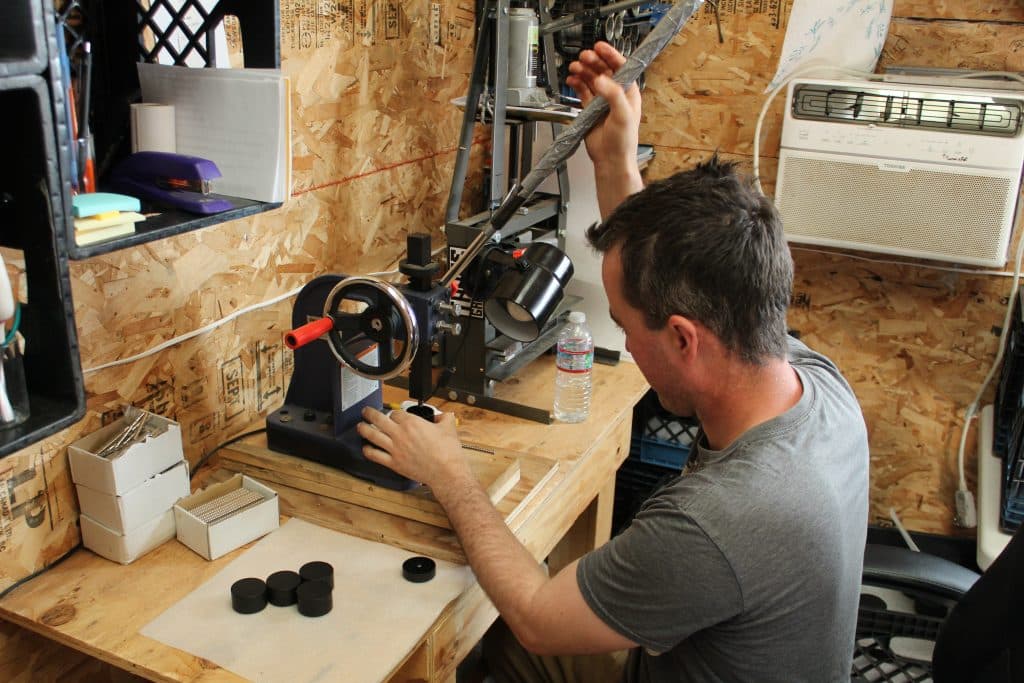
Pictured above: A Tahoe Grinder Company production operator installing rare earth magnets into anodized grinder components prior to laser engraving.
This stage highlights the hands-on assembly process that takes place inside our American manufacturing facility, reinforcing our commitment to quality control and precision craftsmanship.
The use of high-strength neodymium magnets also contributes to the premium feel of the finished grinder. A secure magnetic closure enhances user confidence, protects ground material during transport, and maintains proper component positioning during grinding.
Following magnet installation, grinder components move to the next stage of production — laser processing — where branding, artwork, and product identification details are permanently engraved into the anodized surfaces.
Laser Processing – Custom Designs and Branding
After precision machining, surface finishing, anodizing, and hardware installation, Tahoe Grinder Company weed grinders move into the laser processing stage. This step transforms each precision-engineered aluminum component into a finished product that reflects both functional performance and artistic identity.
Using advanced laser engraving equipment, every grinder is permanently marked with:
- Tahoe Grinder Company brand logo engraving
- custom top artwork designs
- product identification and sizing markings
Laser processing allows extremely fine detail to be applied to anodized aluminum surfaces without affecting structural integrity or dimensional accuracy. The engraving process removes only a microscopic layer of the anodized coating, revealing crisp, high-contrast artwork that will not wear off through normal use.
Rather than placing a simple logo on the top surface, Tahoe Grinder Company grinders are designed to feature visually striking artwork that reflects individuality, lifestyle expression, and premium design philosophy. Each grinder becomes more than a functional herb preparation tool — it becomes a conversation piece that can be proudly displayed on a desk, coffee table, or personal collection shelf.

Pictured above: A freshly laser-engraved grinder featuring the iconic Great Wave off Kanagawa artwork being photographed immediately after processing.
This stage highlights the sharp engraving detail and contrast created by the laser system, showcasing the aesthetic quality that sets Tahoe Grinder Company grinders apart from generic mass-produced alternatives.
Laser engraving also ensures long-term durability of branding and design elements. Unlike printed graphics or applied decals, laser-engraved artwork becomes a permanent part of the grinder surface, maintaining visual clarity even after years of handling and daily use.
By combining precision manufacturing with expressive artistic design, Tahoe Grinder Company delivers grinders that offer both high-performance functionality and distinctive visual appeal — reinforcing our commitment to producing some of the most thoughtfully engineered and aesthetically refined American-made weed grinders available.
Spacer Installation – Smooth Frictionless Rotation
A precision spacer ring is installed to create a friction-optimized interface between rotating grinder components.
This design reduces long-term wear and ensures smooth grinding action while preventing metal-on-metal contact. Even though anodized aluminum is highly durable, this additional engineering step further enhances grinder longevity.
Final Packaging – Protection and Customer Experience
Finished grinders are carefully packaged using protective foam insulation, cushioning materials, and secure shipping containers.
Customers also receive:
- free branded stickers
- selected free gift from checkout
- protective presentation packaging
This ensures that every grinder arrives in perfect condition.
Lifetime Performance – Built to Last
The final step in manufacturing America’s best weed grinders is delivery to the customer.
Tahoe Grinder Company grinders are engineered for long-term durability, precision performance, and lifetime usability. By combining in-house CNC machining, professional American anodizing, strict quality control, and thoughtful engineering design, we create weed grinders that stand apart from mass-produced alternatives.