(What to Watch For, What to Avoid)
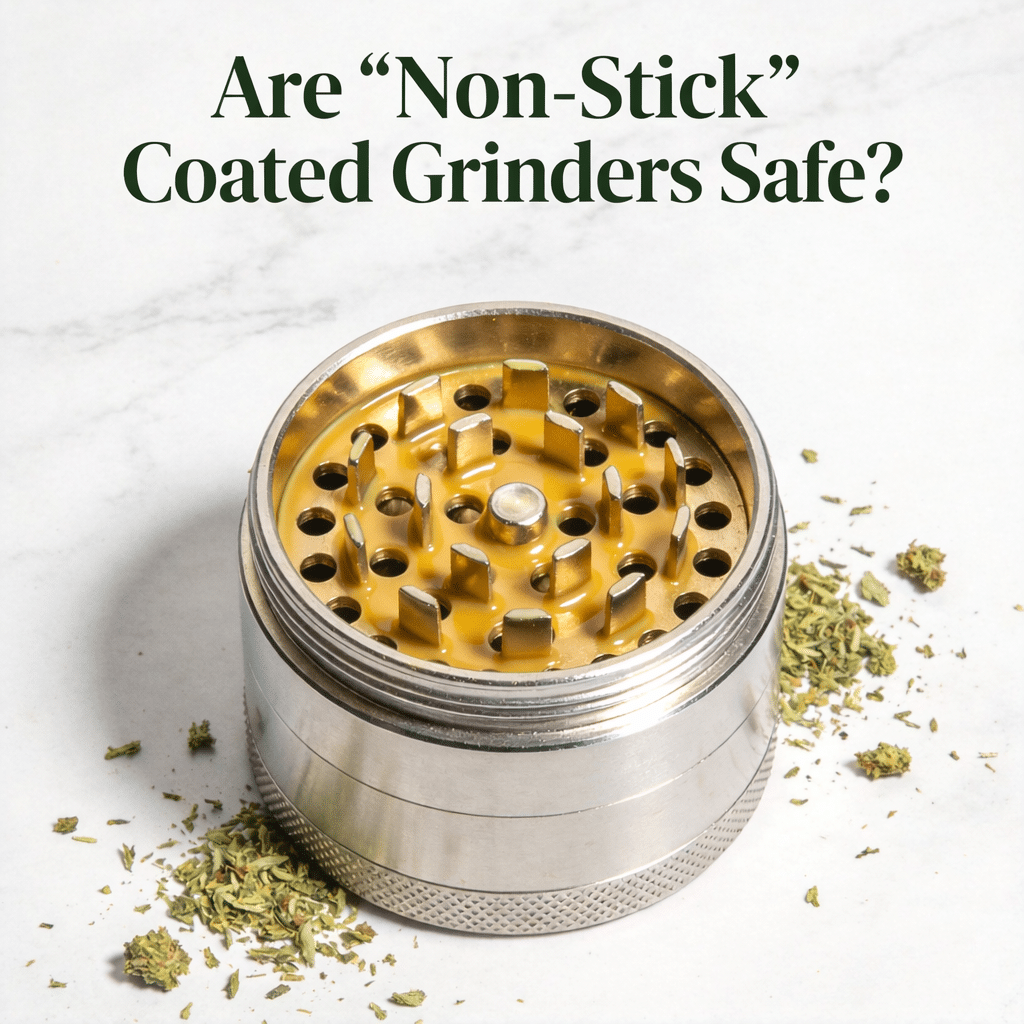
“Non-stick” grinders sound appealing. Less resin buildup. Easier turning. Less cleaning. But in 2026, non-stick coatings are one of the most misunderstood — and potentially risky — features in the grinder market.
Some coatings are relatively inert. Others are poorly applied, wear quickly, or were never designed for repeated friction and heat exposure. The problem isn’t the idea of non-stick — it’s what the coating actually is, how it’s applied, and how it behaves over time.
This guide explains:
- What “non-stick” actually means
- Which coatings are relatively safer
- Which coatings to avoid
- How coating wear happens
- What matters more than non-stick claims
No scare tactics. Just reality.
What “Non-Stick” Means in Grinder Marketing
There is no universal definition of “non-stick” for grinders.
The term may refer to:
- PTFE-based coatings
- Painted or sprayed finishes
- Ceramic-style coatings
- Powder coating
- Anodized aluminum (often mislabeled as non-stick)
These are not the same thing.
Understanding the difference is critical.
Why Coatings Exist on Grinders
Manufacturers add coatings to:
- Reduce resin adhesion
- Improve aesthetics
- Hide machining marks
- Lower production cost
- Compensate for poor tolerances
A coating should never be used to fix bad design.
The Core Safety Question
The real question isn’t:
“Is non-stick safe?”
It’s:
“What happens when the coating wears, flakes, or degrades?”
Because all coatings eventually wear.
Common Grinder Coatings (Ranked by Risk)
1. Painted or Sprayed Coatings (Highest Risk)
These are the most concerning.
Characteristics:
- Thin paint-like layer
- Often glossy or matte
- Can chip or flake
- Applied after machining
Why to avoid
- Paint is not designed for abrasion
- Flakes can mix with flower
- Wear is inevitable with grinding motion
- Heat accelerates degradation
If you can scratch it with a fingernail or see wear marks early — that’s a red flag.
2. PTFE / “Teflon-Style” Coatings (Situational Risk)
PTFE itself is chemically inert when intact.
The issue is mechanical wear.
Concerns:
- PTFE is soft
- Grinding action abrades it
- Microparticles can shed over time
- Long-term exposure hasn’t been studied for inhalation contexts
PTFE is great for cookware because food doesn’t grind against it repeatedly.
Grinders are different.
3. Ceramic-Style Coatings (Moderate Risk)
These vary widely in quality.
Good ceramic coatings:
- Are baked on
- Bond tightly
- Wear slowly
Cheap ceramic coatings:
- Chip
- Flake
- Fail at edges and teeth
Without transparency about the process, it’s hard to assess safety.
4. Powder Coating (Mixed Risk)
Powder coating is thicker and more durable than paint.
However:
- It’s still a coating
- Can wear at teeth
- Is not designed for shear forces
Better than paint — still not ideal for internal surfaces.
5. Anodized Aluminum (Lowest Risk, Often Misunderstood)
Anodizing is not a coating.
It is:
- An electrochemical conversion of the aluminum surface
- Inert and non-reactive
- Bonded at the molecular level
- Extremely wear-resistant
Proper anodizing does not flake, peel, or shed.
This is why anodized aluminum is widely used in:
- Medical tools
- Food equipment
- Aerospace components
When done correctly, anodizing is the gold standard.
Why Wear Matters More Than Marketing Claims
Every grinder experiences:
- Friction
- Pressure
- Heat
- Resin adhesion
- Repeated motion
If a coating wears:
- Material goes somewhere
- That “somewhere” is often your flower
The question is what material that is.
Signs a Coated Grinder Is Wearing Poorly
Watch for:
- Visible scratches through coating
- Color transfer on flower
- Flakes or dust in chambers
- Sticky patches where coating is gone
- Uneven resistance while turning
If the surface changes — stop using it.
Why Bare or Anodized Metal Often Performs Better Long-Term
Non-stick sounds convenient, but:
- Smooth machining reduces sticking naturally
- Proper tolerances matter more than coatings
- Regular cleaning prevents buildup
- Consistent surfaces age predictably
A well-designed grinder doesn’t need gimmicks.
Heat + Coatings: An Overlooked Factor
Grinding generates frictional heat.
Heat:
- Accelerates coating breakdown
- Softens polymers
- Changes adhesion behavior
This is why coatings degrade faster in grinders than in static applications.
Flavor and Contamination Considerations
Coatings can:
- Trap resin unevenly
- Hold odors
- Affect terpene clarity
- Introduce off-tastes as they age
Bare or anodized metal remains neutral over time.
What to Look For If You’re Evaluating a “Non-Stick” Grinder
Ask:
- What is the coating made of?
- Is it applied internally or externally only?
- How does it wear?
- Is it food-contact rated?
- What happens when it scratches?
Vague answers = caution.
What to Avoid (Simple Checklist)
Avoid grinders that:
- Don’t disclose coating type
- Use paint on internal surfaces
- Show early wear
- Feel sticky once coating degrades
- Rely on coating to function smoothly
Final Verdict
Not all “non-stick” grinders are unsafe — but many are unnecessary, and some are poorly executed.
The safest long-term options are:
- Properly anodized aluminum
- Well-machined bare metal
- Designs that don’t rely on coatings at all
Non-stick coatings don’t replace good engineering.
If a grinder needs a coating to work well, that’s usually a design problem — not a feature.
Final Takeaway
The question isn’t whether non-stick grinders are safe today.
It’s whether they’re safe after months or years of abrasion.
In grinders, durability and material integrity matter more than convenience claims.
Choose materials that don’t change over time — because anything that wears eventually ends up somewhere.
And with grinders, “somewhere” matters.