
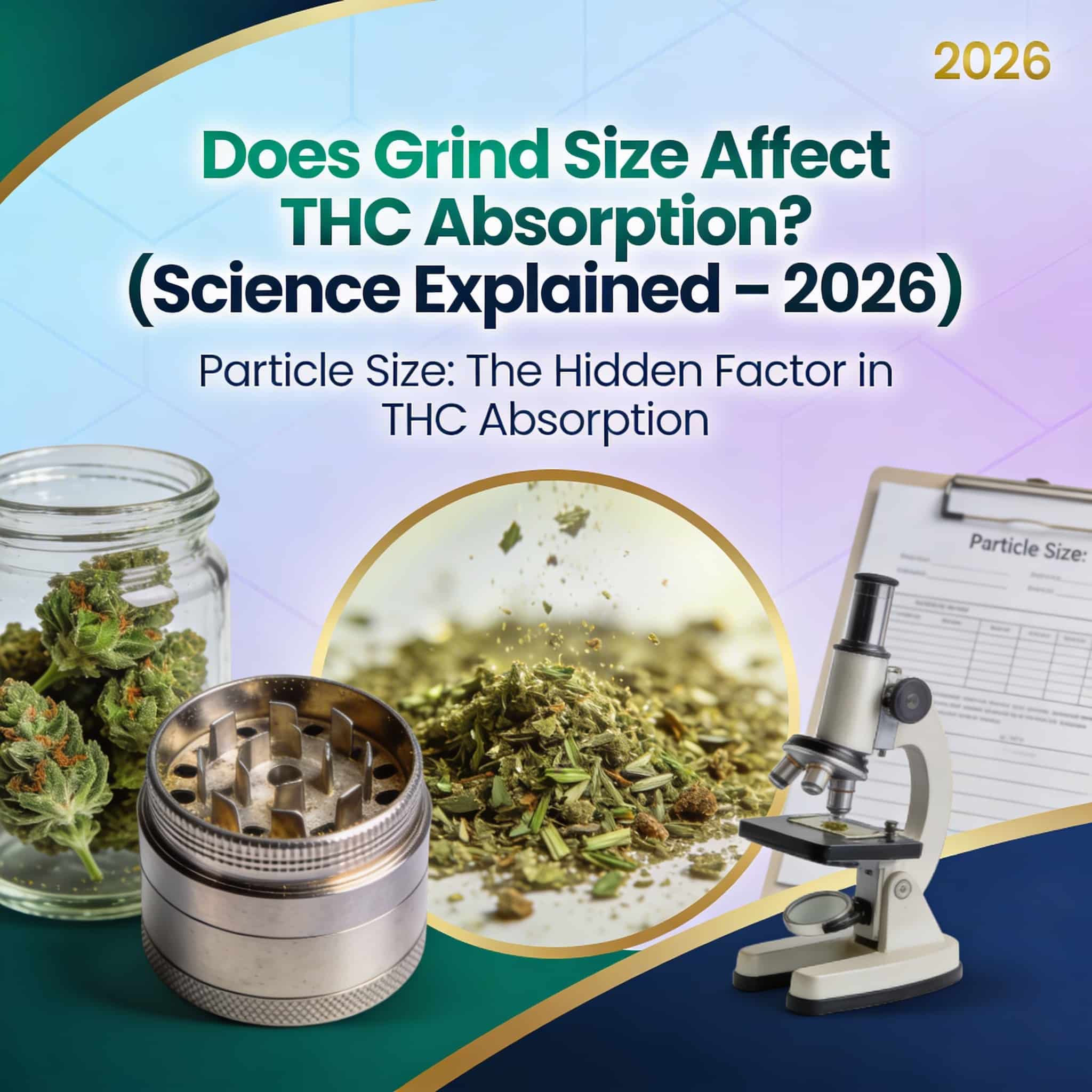
Grind size is one of the most misunderstood — and most important — variables in cannabis consumption. While many users obsess over strain potency, terpene profiles, and THC percentages, they often overlook a critical factor that directly determines how much THC actually reaches the body: particle size.
In 2026, cannabis flower is denser, stickier, and more chemically complex than ever before. That evolution has made grind size more influential than it was even a few years ago. The way flower is broken down affects surface area, airflow, combustion temperature, vaporization efficiency, and ultimately THC absorption.
So does grind size really affect how high you get?
Yes — and the science behind it is clearer than most people realize.
THC Absorption Starts With Exposure, Not THC Percentage
THC does not absorb into the body simply because it exists in the flower. For THC to enter the bloodstream, it must first be:
- Released from plant material
- Heated to the appropriate temperature
- Carried in smoke or vapor
- Inhaled efficiently
Grind size directly affects every step of this process.
The Science of Surface Area and Cannabinoid Release
At a molecular level, THC and other cannabinoids are stored in trichomes on the surface of cannabis flower. Grinding increases the total exposed surface area of these trichomes.
However, more surface area does not automatically mean better THC absorption.
There is an optimal range.
Too little surface area limits cannabinoid release.
Too much surface area disrupts airflow and combustion.
Effective THC absorption requires balance, not extremes.
Fine Grind vs Medium Grind vs Coarse Grind
Fine Grind: Maximum Exposure, Minimum Efficiency
A fine grind dramatically increases surface area, but it introduces several problems:
- Restricted airflow
- Higher combustion temperatures
- Faster burn rate
- Increased loss of THC through sidestream smoke
Fine particles compact easily, reducing oxygen flow. This causes uneven burning and localized overheating, which can destroy cannabinoids before inhalation.
Result:
High THC content on paper, lower THC absorbed in practice.
Coarse Grind: Poor Exposure, Uneven Combustion
A coarse grind preserves structure but limits exposure:
- Reduced trichome surface area
- Inconsistent heat distribution
- Incomplete combustion
Large chunks burn unevenly, allowing some cannabinoids to remain unheated or only partially activated.
Result:
Lower THC extraction and wasted material.
Medium Grind: Optimal THC Absorption
A medium, fluffy, uniform grind produces the best real-world results:
- Balanced surface area
- Consistent airflow
- Stable combustion temperature
- Even cannabinoid release
This grind allows THC to volatilize efficiently while maintaining airflow that carries cannabinoids into the lungs instead of destroying them.
Airflow Is the Hidden Variable Most People Ignore
THC absorption is not just about heat — it’s about transport.
Airflow determines:
- How evenly heat spreads
- How smoke or vapor moves
- How long cannabinoids remain suspended
Poor airflow traps heat and destroys THC.
Good airflow preserves cannabinoids and improves inhalation efficiency.
Grind size controls airflow more than any other variable in dry flower consumption.
Combustion Temperature and THC Degradation
THC begins to degrade at high temperatures. When flower burns too hot — often caused by fine grind compaction — THC converts into less psychoactive compounds.
Fine grind problems:
- Hot spots
- Rapid burn
- Excessive ash production
Medium grind benefits:
- Controlled burn rate
- Lower peak temperatures
- Better cannabinoid preservation
Lower, more stable temperatures mean more THC reaches the lungs intact.
Vaporization vs Combustion: Grind Size Still Matters
Even with vaporizers, grind size affects THC absorption.
- Too fine: airflow restriction, uneven heating
- Too coarse: poor extraction, reduced efficiency
Most modern dry herb vaporizers perform best with a medium grind that allows heat to circulate without compressing material.
Moisture Content and Grind Size Interaction
In 2026, flower tends to retain more moisture due to terpene preservation techniques.
Moist flower + fine grind =
- Clumping
- Channeling
- Uneven airflow
A medium grind helps compensate by maintaining structure and preventing compression.
Why Better Grind Does Not Mean Stronger Weed
A common misconception is that a finer grind makes weed “stronger.”
In reality:
- THC content remains unchanged
- Delivery efficiency changes
Grind size affects how much THC you absorb, not how much exists in the flower.
Better grind = better delivery, not higher potency.
THC Absorption Is About Efficiency, Not Aggression
Aggressive grinding feels productive, but it often works against absorption.
Efficient THC delivery depends on:
- Controlled exposure
- Stable airflow
- Predictable heat
Medium grind wins because it optimizes the entire system.
Real-World Testing and User Experience
Experienced users consistently report that:
- Medium grind produces smoother hits
- Sessions feel stronger despite using less flower
- Harshness decreases
- Flavor improves
This aligns with combustion science and airflow physics.
Why Grinder Design Matters as Much as Grind Size
Not all grinders produce the same grind, even at the same “setting.”
Good grinders:
- Slice flower cleanly
- Preserve structure
- Minimize powder
Poor grinders:
- Crush and smear
- Produce dust
- Create inconsistent particle sizes
Inconsistent grind undermines THC absorption regardless of size.
The THC Absorption Sweet Spot
Based on combustion physics, airflow behavior, and cannabinoid stability, the optimal grind for THC absorption in 2026 is:
- Medium
- Uniform
- Fluffy
- Non-compacting
This applies across glass pipes, joints, bongs, and vaporizers.
Why This Matters More in 2026 Than Ever Before
Modern flower:
- Has higher resin density
- Burns hotter
- Produces more residue
This amplifies the negative effects of poor grind size and rewards precision more than ever.
Final Answer: Yes, Grind Size Directly Affects THC Absorption
Grind size absolutely affects THC absorption — not by changing THC content, but by controlling airflow, combustion temperature, and cannabinoid delivery efficiency.
Fine grind wastes THC through heat and airflow restriction.
Coarse grind wastes THC through incomplete exposure.
Medium grind maximizes absorption by balancing both.
In 2026, the most effective way to get more out of your flower isn’t chasing higher THC percentages — it’s optimizing how THC is released and delivered.
Grind size isn’t a preference.
It’s a performance variable.