
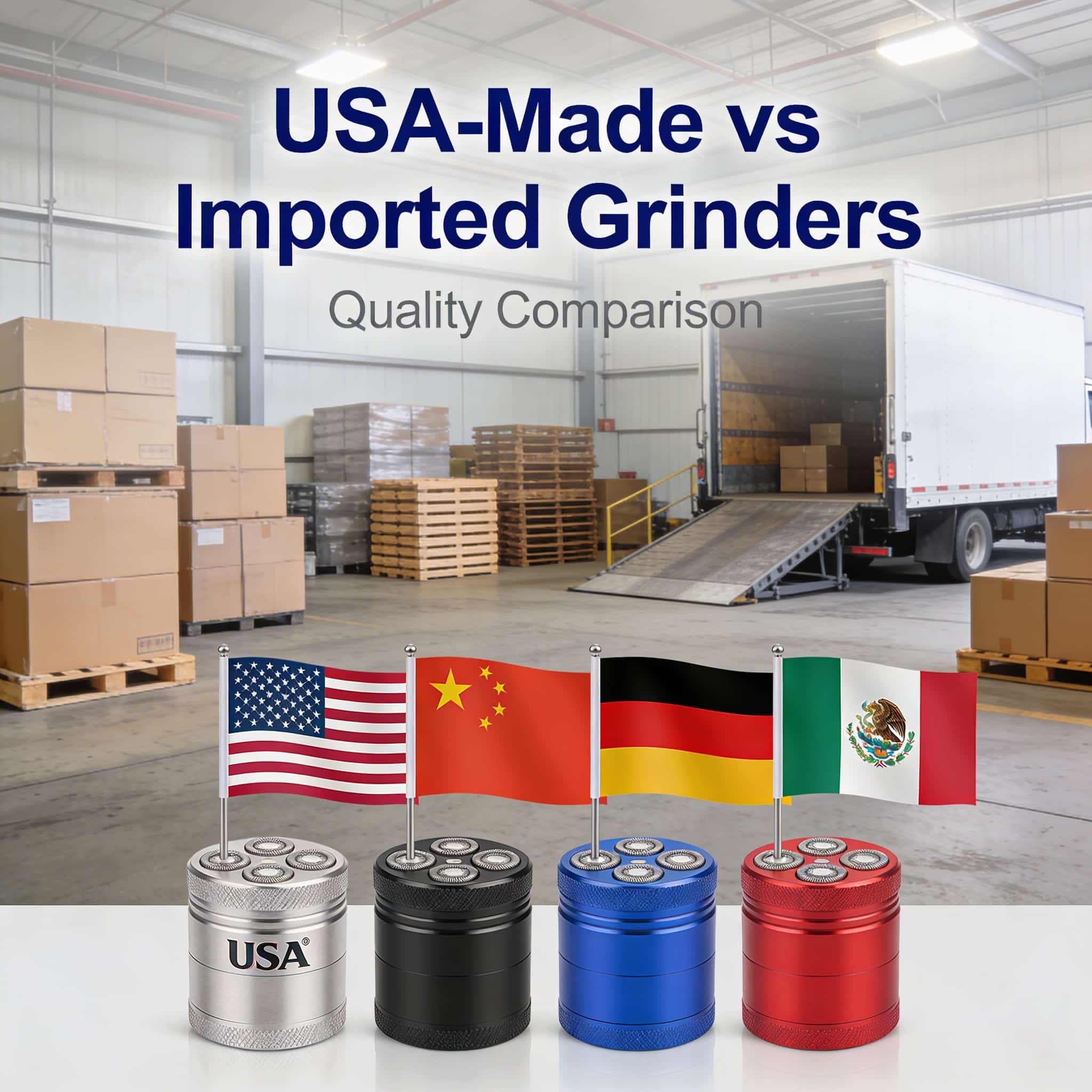
(What Actually Changes: Quality, Tolerances & Warranty)
“Made in the USA” gets thrown around constantly in the grinder market. Sometimes it means something. Sometimes it’s marketing. Imported grinders, meanwhile, range from surprisingly decent to disposable junk.
So what actually changes between USA-made and imported grinders in 2026?
The answer isn’t simple — but it is predictable once you understand manufacturing realities.
This guide breaks down where differences truly matter, where they don’t, and why tolerances, accountability, and warranty support matter far more than flags on packaging.
The Core Difference Isn’t Geography — It’s Control
The biggest difference between USA-made and imported grinders is who controls the manufacturing process.
USA-made grinders typically involve:
- Domestic CNC machining
- In-house quality control
- Direct oversight of materials
- Small-batch or controlled production
- Immediate feedback loops
Imported grinders usually involve:
- Contract factories
- High-volume production
- Limited process transparency
- Inconsistent batch control
- Delayed or minimal QC feedback
Quality is a function of process control, not country — but control is easier domestically.
Tolerances: Where the Real Gap Shows Up
What Tolerances Actually Mean
Tolerance refers to how precise each part is relative to design intent — usually measured in thousandths of an inch.
In grinders, tolerances affect:
- Tooth alignment
- Chamber clearance
- Magnet fit
- Smooth rotation
- Long-term wear
Small differences compound fast.
USA-Made Grinders: Tight, Repeatable Tolerances
Well-run domestic CNC shops typically hold:
- Tight dimensional tolerances
- Consistent tooth geometry
- Reliable magnet seating
- Predictable rotation feel
This leads to:
- Fluffy, uniform grind
- Less binding
- Minimal powder
- Consistent performance across units
Every grinder behaves like the last one.
Imported Grinders: Wider Variance
Imported grinders often vary by batch.
Common issues:
- Slight misalignment
- Uneven tooth height
- Inconsistent chamber clearance
- Variable magnet strength or seating
Some units are great. Others bind, wobble, or wear faster.
The biggest issue isn’t that imported grinders can’t be good — it’s that consistency is harder to guarantee.
Materials: What Changes (and What Doesn’t)
Aluminum
Both USA-made and imported grinders often use aluminum.
The difference is:
- Alloy consistency
- Source transparency
- Heat treatment
- Surface finishing quality
Domestic manufacturing usually allows tighter material traceability.
Anodizing Quality
Anodizing is where many grinders diverge.
High-quality anodizing:
- Is uniform
- Is food-contact safe
- Does not flake
- Is bonded to the aluminum
Lower-quality anodizing:
- Is uneven
- Wears faster
- Can discolor
- May be cosmetic, not functional
This has more to do with process discipline than geography — but domestic shops tend to have stricter controls.
Tooth Design & Machining Strategy
Why Tooth Geometry Matters
Teeth determine:
- Grind consistency
- Resin behavior
- Airflow
- Powder formation
Good teeth slice. Bad teeth crush.
USA-Made Tooth Design
Domestic grinders are more likely to feature:
- Precision-cut teeth
- Controlled spacing
- Consistent depth
- Shearing-focused geometry
This creates:
- Fluffier output
- Better airflow
- Less clogging
- Cleaner bowls
Imported Tooth Design
Many imported grinders use:
- Aggressive tooth profiles
- Simplified machining paths
- Cost-optimized designs
These grind fast but often:
- Produce dust
- Compact flower
- Increase resin smear
- Feel inconsistent
Again — some imported designs are excellent, but variability is common.
Assembly & Quality Control
Domestic QC
USA-made grinders typically undergo:
- Manual inspection
- Test fitting
- Rotation checks
- Magnet alignment verification
If something is off, it gets caught early.
Overseas QC Challenges
Imported grinders often rely on:
- Batch sampling
- Visual inspection only
- Delayed feedback
- Limited corrective loops
Problems sometimes aren’t discovered until customers complain.
Warranty: Where the Difference Becomes Obvious
USA-Based Warranty Support
Domestic grinder companies typically:
- Offer real warranties
- Handle replacements quickly
- Maintain parts availability
- Stand behind machining defects
If something goes wrong, resolution is straightforward.
Imported Grinder Warranty Reality
Imported grinders often:
- Have limited or unclear warranties
- Require overseas returns
- Offer store credit instead of replacement
- Treat grinders as disposable items
Low price often assumes short lifespan.
Longevity: What Actually Lasts Longer
A grinder lasts as long as:
- Teeth remain sharp
- Alignment stays true
- Surfaces resist wear
- Resin buildup remains manageable
USA-made grinders tend to:
- Wear evenly
- Maintain alignment
- Age predictably
- Perform consistently over years
Imported grinders vary widely — some last years, others degrade quickly.
Cost: Why USA-Made Grinders Cost More
You’re paying for:
- Labor
- Machine time
- Small-batch production
- Quality control
- Warranty support
- Accountability
You’re not paying for magic.
When Imported Grinders Make Sense
Imported grinders can be a good choice if:
- Budget is the primary concern
- You’re okay with variability
- You treat grinders as semi-disposable
- Warranty isn’t important
- Performance consistency isn’t critical
They’re not automatically bad — just less predictable.
When USA-Made Grinders Make Sense
USA-made grinders shine when:
- You value consistency
- You use sticky, dense flower
- You want predictable grind behavior
- You expect long service life
- You care about warranty support
They’re built to be tools, not consumables.
The Biggest Myth: “USA-Made Means Perfect”
No grinder is perfect.
Domestic manufacturing doesn’t eliminate:
- User error
- Resin buildup
- Abuse
- Poor cleaning habits
It just reduces variability and improves accountability.
What Actually Matters Most (Checklist)
More important than country of origin:
✔ Tight tolerances
✔ Good tooth geometry
✔ Proper alignment
✔ Quality anodizing
✔ Strong magnet seating
✔ Real warranty
Those traits are more common in USA-made grinders — but not exclusive to them.
Final Takeaway
The real difference between USA-made and imported grinders isn’t patriotism — it’s process control and accountability.
USA-made grinders tend to offer:
- Better consistency
- Tighter tolerances
- Predictable performance
- Real warranty support
Imported grinders offer:
- Lower upfront cost
- Wider variability
- Shorter expected lifespan
Neither choice is wrong — but they serve different users.
If you want a grinder that behaves the same every time, ages gracefully, and is backed by real support, USA-made grinders justify their price.
If you want cheap and functional, imports can work — just understand what you’re trading off.
In grinders, precision and accountability matter more than geography — but geography often determines who’s accountable.