
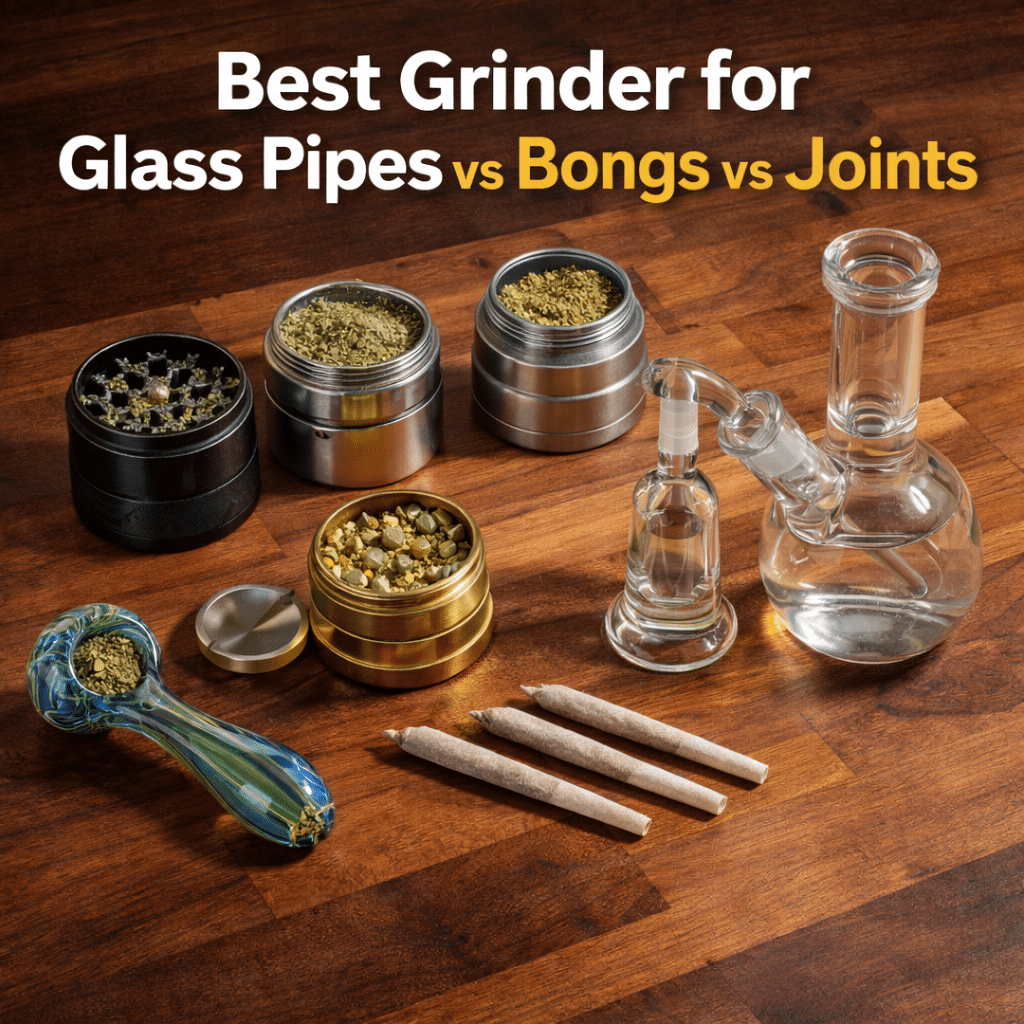
One of the biggest mistakes cannabis users make is assuming that one grinder setup works equally well for every smoking method. In reality, glass pipes, bongs, and joints all rely on very different airflow and combustion mechanics—and those differences dramatically change what a grinder needs to do.
A grinder that performs perfectly for joints may feel harsh or clog-prone in a glass pipe. A grinder optimized for bongs may over-process flower for joints. This isn’t preference—it’s physics.
In 2026, with modern cannabis flower being denser, stickier, and more terpene-rich than ever, matching grinder characteristics to smoking method matters more than it used to.
This guide breaks down exactly what kind of grinder works best for glass pipes, bongs, and joints—and why.
Why Smoking Method Dictates Grinder Choice
Grinding weed is not just size reduction. It determines:
- Airflow through the flower
- Heat distribution
- Combustion speed
- THC and terpene preservation
Each smoking method imposes different demands on these variables.
Best Grinder for Glass Pipes
Why Glass Pipes Are the Most Demanding
Glass pipes are the most unforgiving smoking method:
- No water filtration
- No paper buffer
- Direct airflow
- Immediate heat exposure
Any grind flaw is instantly noticeable.
Ideal Grind for Glass Pipes
Glass pipes require a grind that is:
- Medium
- Fluffy
- Uniform
- Structurally intact
This allows air to move evenly through the bowl while preventing overheating and clogging.
Grinder Traits That Work Best for Glass Pipes
The best grinder for glass pipes in 2026 should have:
- Precision-cut slicing teeth (not crushing teeth)
- Excellent alignment to maintain consistency
- Anodized aluminum construction to resist resin
- Medium size (around 60–65mm)
- Controlled grind output (not powdery)
Aggressive grinders destroy airflow. Cheap grinders choke bowls.
What Fails in Glass Pipes
Avoid grinders that:
- Produce fine powder
- Smash flower
- Use painted or coated surfaces
- Have poor tooth geometry
Glass pipes magnify every flaw.
Best Grinder for Bongs
Why Bongs Are More Forgiving—but Still Demanding
Bongs introduce water filtration, which:
- Cools smoke
- Softens harshness
- Masks some grind inconsistencies
But bongs also require good snap behavior and airflow control.
Ideal Grind for Bongs
Bongs perform best with:
- Medium to slightly coarse grind
- Consistent particle size
- Minimal powder
Too fine = pull-through and dirty water
Too coarse = incomplete combustion
Grinder Traits That Work Best for Bongs
The best grinder for bongs should offer:
- Slightly more aggressive teeth than glass pipe grinders
- Consistent output across loads
- Good chamber volume
- Stable alignment under torque
Medium-sized grinders still perform best here.
3-Piece vs 4-Piece for Bongs
- 3-piece grinders preserve moisture and structure
- 4-piece grinders can work, but excessive kief separation dries flower
For bongs, maintaining structure matters more than kief collection.
Best Grinder for Joints
Why Joints Have Different Requirements
Joints burn slowly and continuously, relying on:
- Paper combustion
- Even heat distribution
- Stable airflow along the length
Joints are more forgiving—but demand burn consistency.
Ideal Grind for Joints
Joints prefer a grind that is:
- Slightly finer than glass pipes
- Still consistent and uniform
- Free of chunks and dust
Uneven grind causes canoeing and runs.
Grinder Traits That Work Best for Joints
The best grinder for joints in 2026 should provide:
- Uniform particle size
- Predictable output
- Smooth rotation
- Ability to control grind duration
Too aggressive = dust
Too gentle = chunks
Grinder Size for Joint Smokers
Joint smokers often benefit from:
- Medium grinders for daily use
- Larger grinders for group rolling
However, precision still beats capacity.
Why “One Grinder for Everything” Is a Myth
While some grinders perform better across methods, no grinder excels equally everywhere unless it:
- Produces consistent medium grind
- Preserves structure
- Allows user control
- Maintains alignment
This is why precision grinders outperform aggressive designs across all methods.
Material Matters Across All Methods
Regardless of smoking method, grinders should avoid:
- Plastic or polymer bodies
- Painted or decorative coatings
- Zinc alloys
Anodized aluminum remains the best balance of:
- Durability
- Safety
- Resin resistance
- Grind control
Stainless steel works but introduces weight and friction tradeoffs.
Grinder Size Summary by Method
| Method | Best Grinder Size |
|---|---|
| Glass Pipes | ~63mm |
| Bongs | 63–75mm |
| Joints | 45–63mm |
Mid-size grinders dominate because they preserve airflow while maintaining control.
Grind Consistency Beats Grind Fineness
Across all methods, consistency matters more than how fine the grind is.
- Consistent medium grind > aggressive fine grind
- Predictable output > speed
- Structure > powder
Good grinders don’t force results—they enable control.
Final Verdict
The best grinder depends on how you smoke:
- Glass pipes demand precision, airflow, and restraint
- Bongs reward consistency and controlled aggression
- Joints require uniformity and burn stability
In 2026, the best grinders aren’t defined by hype or weight—they’re defined by predictable, repeatable performance across real-world conditions.
Match the grinder to the method, and everything downstream improves.
Grind smarter—not harder.