
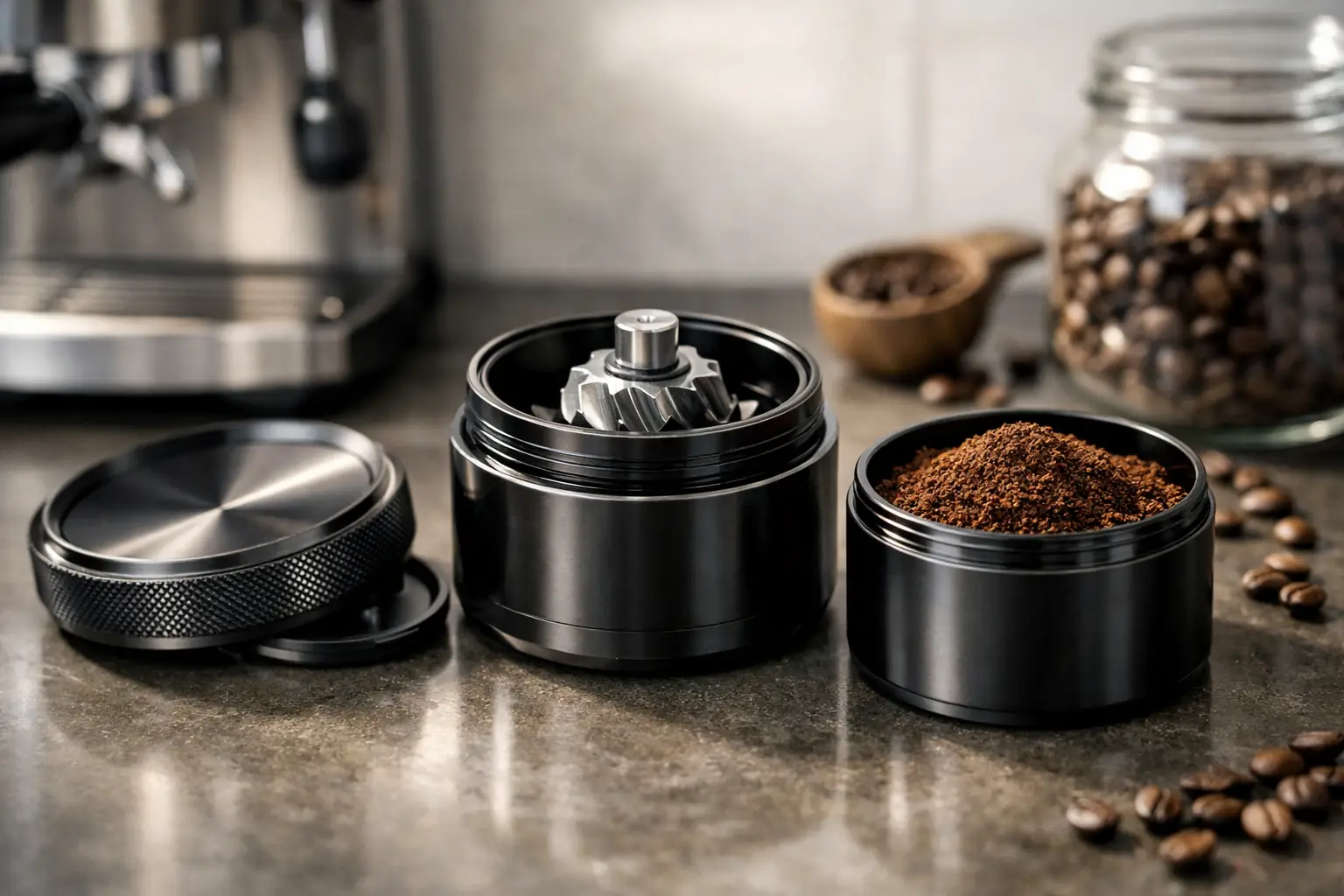
A grinder that starts binding after a few weeks is not a minor annoyance. It slows down every session, makes a mess, and reminds you exactly where cheap construction shows up first. That is why threadless grinder benefits matter more than most buyers realize. When you remove threads from the design, you remove one of the most common failure points in a weed grinder.
For anyone who uses dry herb regularly, that change has real performance value. A threadless grinder is built to open and close without the twisting motion that traditional threaded lids depend on. Instead, the top is usually secured with magnets and precision-machined mating surfaces. Done right, that means quicker access, fewer jams, and a grinder that keeps working the way it should.
Why threadless grinder benefits stand out in daily use
The biggest advantage is simple – less friction where you do not want it. Traditional threaded grinders rely on small ridges cut into the metal so the lid can screw on and off. Over time, those threads collect sticky resin, fine herb particles, and pocket debris. Once buildup starts, the lid can feel gritty, misaligned, or fully stuck.
A threadless design avoids that problem by eliminating the threaded path entirely. You lift the lid off, load your herb, grind, and remove the top again without fighting a ring of packed residue. That sounds like a small upgrade until you have used both styles for a while. Then it becomes obvious which one is faster and less frustrating.
This matters even more for people who grind often. If you are preparing flower every day, tiny inefficiencies add up. A grinder should feel predictable every single time you pick it up. It should not need extra force, awkward wrist motion, or cleanup just to open correctly.
Faster access and less interruption
One of the clearest threadless grinder benefits is speed. With a magnetic lid, there is no need to line up threads, spin the cap multiple turns, or backtrack when the lid catches at the wrong angle. You remove the top and get to work.
That sounds basic because it is. Good design usually does. A premium grinder should reduce motion, not add it.
This is especially noticeable when your hands are dry, sticky, tired, or cold. Threaded lids can become annoying fast under real-world conditions. A threadless magnetic top is easier to manage because it depends on fit and hold strength rather than rotational alignment. The result is a cleaner workflow from loading to grinding to pouring.
Less clogging where grinders usually fail
Threads are one of the easiest places for resin to collect. Fine plant matter gets pressed into the grooves, oils from sticky flower build up, and suddenly opening the grinder becomes harder than grinding the herb. That is a design issue, not just a maintenance issue.
Threadless grinders shift that wear pattern. Since there are no threads to trap residue, there are fewer narrow channels for material to cake into. You still need to clean any grinder eventually, especially if you run dense, resin-heavy flower through it, but the maintenance tends to be simpler and less frequent.
That is a major quality-of-life improvement for buyers who are tired of using a toothbrush or scraping tool just to make their grinder functional again. A serious grinder should hold up under actual use, not only look good on day one.
Better long-term feel
A lot of low-end grinders feel decent at first. The problem is what happens after months of use. Threads wear. Coatings chip. Tolerances get sloppy. The lid starts wobbling or cross-threading. What felt solid in the beginning turns into a grinder you have to baby.
A well-machined threadless grinder can age better because its performance is not tied to preserving fine threads through repeated cycles. The key phrase there is well-machined. If the tolerances are loose, a threadless lid can feel cheap and unstable. If the machining is precise, the opposite happens – the grinder feels clean, intentional, and mechanically confident every time you open it.
That difference is where premium manufacturing matters. Material choice matters too. Strong aluminum construction, accurate tooth geometry, and tight fit between parts are what make a threadless grinder feel like a tool instead of a novelty.
Threadless grinder benefits and cleaner operation
There is also a cleanliness advantage that gets overlooked. When you twist a threaded lid on and off, you are creating more contact across surfaces that can drag resin and particles into corners. Over time, that can make the grinder feel dirtier than it should.
Threadless opening is more direct. Lift off, replace, repeat. With fewer contact points designed to interlock, cleanup is generally easier and residue has fewer places to hide. That does not mean no maintenance. It means maintenance is less annoying.
For many users, that alone is enough reason to switch. A grinder is one of the most touched tools in any smoking setup. If it stays cleaner and opens easier, the whole experience improves.
A better fit for larger grinders
Threadless designs make particular sense on larger grinders. Once you move up in size, the lid diameter increases and threaded tops can become more awkward to turn smoothly, especially if there is any buildup. A magnetic threadless top keeps access simple even when the grinder has more surface area and more grinding capacity.
That is useful for people who prep more herb at once, share with friends, or simply prefer the hand feel of a bigger grinder. You get the capacity and leverage benefits of a larger model without adding unnecessary hassle to the opening and closing motion.
Are there any trade-offs?
There can be, depending on how the grinder is made. A weak magnetic lid is not an upgrade. If the magnet strength is poor or the lid fit is sloppy, the top can feel insecure compared to a threaded cap. That is why threadless is not automatically better in every version on the market.
The real comparison is not threaded versus threadless in the abstract. It is cheap manufacturing versus precision manufacturing. A badly made threadless grinder will still disappoint. A properly engineered one gives you the convenience of a magnetic lid without sacrificing control or confidence.
Some users also like the locked-in feeling of a screw top, especially if they carry a grinder in a bag often. That preference is fair. But in premium threadless designs, strong magnets and tight machining usually provide more than enough hold for everyday use. For most people, the faster access and reduced clogging are worth the switch.
Why serious users notice the difference faster
If you only grind occasionally, almost any grinder can seem acceptable for a while. The more often you use it, the more quickly weak points show up. Teeth geometry affects consistency. Material quality affects durability. Surface finish affects residue buildup. Thread design, or the absence of it, affects how the grinder behaves after repeated sessions.
That is why experienced users tend to appreciate threadless construction sooner. They know what it feels like when a lid starts sticking, when threads begin to grind against each other, or when opening the grinder becomes its own chore. They are not paying for a gimmick. They are paying to remove failure points.
For buyers upgrading from bargain grinders, this is one of the easiest differences to feel immediately. You do not need a technical explanation once the lid comes off cleanly and goes back on without resistance. The design proves itself through use.
What to look for in a threadless grinder
If you are shopping based on threadless grinder benefits, do not stop at the words threadless or magnetic. Look at the full build. You want precision-machined parts, high-grade aluminum, strong magnets, sharp and consistent teeth, and a finish that can handle real use without degrading.
You should also think about configuration. A 2-piece grinder keeps things simple and compact. A 3-piece adds storage and separation. A 4-piece gives you a more complete setup for filtering and collection. Threadless design can improve the user experience in any of those formats, but the right choice depends on how you use your grinder.
Tahoe Grinder Co builds around that idea – better engineering first, convenience second, and no tolerance for weak points that show up under actual daily use. That is the standard serious buyers should expect.
A grinder is not supposed to be the problem in your setup. If it opens cleanly, stays functional longer, and gets out of your way every time you use it, that is not extra. That is what good design should have been doing all along.