
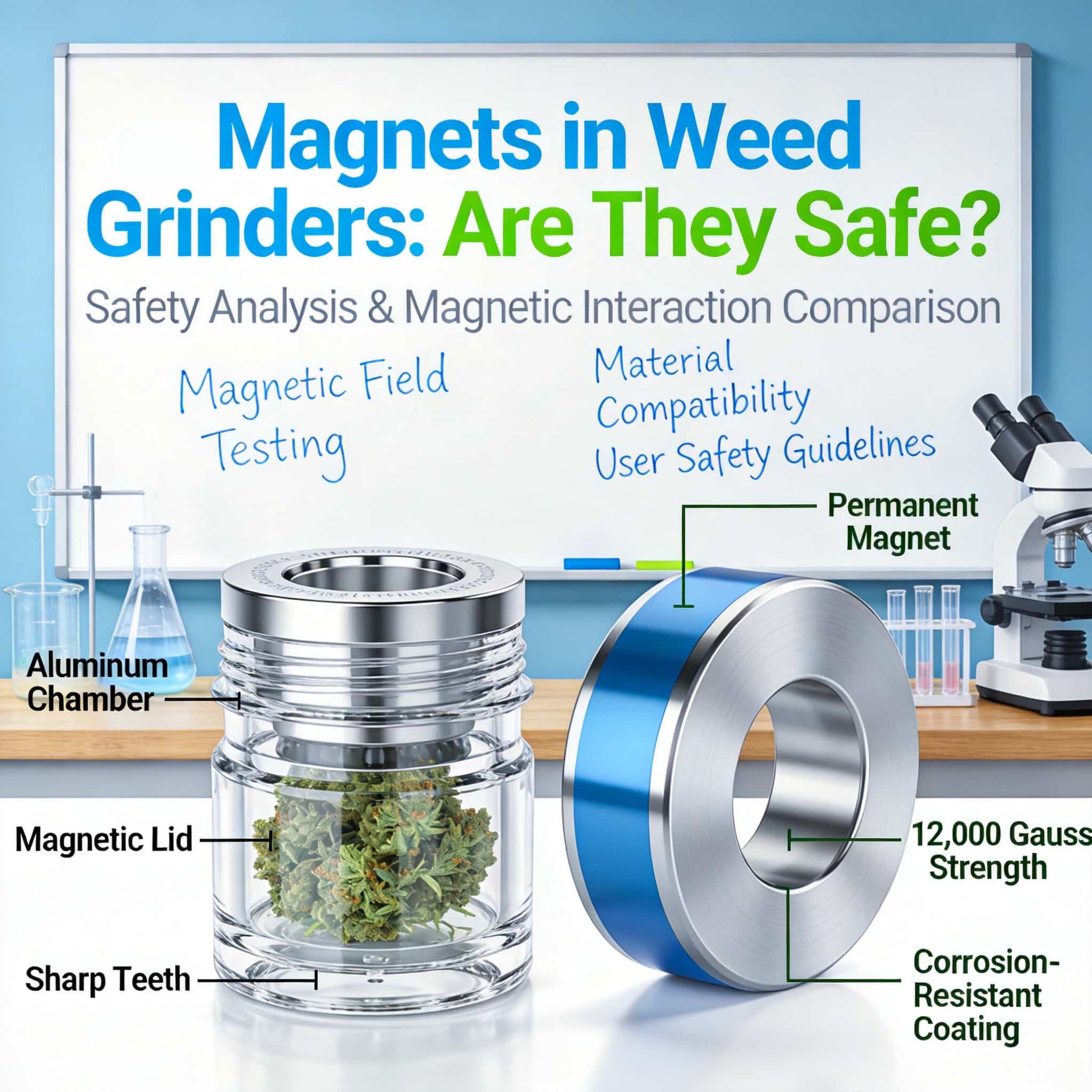
(Materials, Placement & Long-Term Durability)
Magnetic weed grinders are now the standard in premium designs. They’re smoother to use, faster to open, and eliminate thread wear. But any time magnets are involved, people ask the same questions:
- Are magnets safe around weed?
- Can they shed particles?
- Do they affect potency?
- Do magnets wear out or fail?
- What happens if a magnet comes loose?
This guide breaks down what grinder magnets are made of, how they’re installed, why placement matters, and what actually determines long-term safety and durability.
No hype. No fear-mongering. Just how they work.
Why Grinders Use Magnets at All
Magnets solve several real mechanical problems:
- Eliminate thread binding
- Maintain perfect alignment
- Speed up opening and closing
- Reduce resin buildup in threads
- Improve long-term consistency
A magnetic grinder isn’t a gimmick — it’s a mechanical upgrade.
What Kind of Magnets Are Used in Weed Grinders?
Almost all quality grinders use neodymium magnets.
Neodymium Magnets (NdFeB)
Characteristics:
- Extremely strong for their size
- Stable magnetic field
- Widely used in electronics, medical devices, and tools
Neodymium magnets are solid metal alloys, not coated powders or composites.
Do Magnets Affect Weed or THC?
No.
Magnets:
- Do not alter cannabinoids
- Do not change terpene structure
- Do not affect potency
- Do not interact chemically with plant material
Cannabis compounds are not magnetic.
The magnetic field strength involved is trivial compared to anything that could influence chemistry.
This concern is a myth.
The Real Safety Question: Placement, Not Magnetism
The important factor isn’t the magnet — it’s where and how it’s installed.
Proper Magnet Placement
In well-designed grinders:
- Magnets are recessed
- Sealed into machined pockets
- Isolated from direct contact with flower
- Fixed permanently with press-fit or adhesive
This makes them functionally invisible during use.
Poor Magnet Placement (What to Avoid)
Red flags include:
- Exposed magnets inside grinding chambers
- Magnets flush with cutting surfaces
- Loose magnets
- Visible gaps around magnet edges
Magnets should never be in the grinding path.
Can Grinder Magnets Shed Material?
High-quality neodymium magnets:
- Do not shed
- Do not flake
- Do not degrade mechanically under normal use
Problems only arise if:
- The magnet isn’t properly seated
- Adhesive fails
- The grinder experiences severe impact
- Cheap coatings are used on the magnet surface
This is a design and manufacturing issue — not a magnet issue.
Magnet Coatings: What Matters
Neodymium magnets are often coated to prevent corrosion.
Common coatings:
- Nickel
- Nickel-copper-nickel
- Epoxy
In quality grinders:
- Magnets are sealed and isolated
- Coating never contacts flower
- Wear is not a factor
If you can see a magnet rubbing or exposed — that’s a problem.
Will Grinder Magnets Lose Strength Over Time?
Under normal use: No.
Neodymium magnets lose strength only if:
- Heated above ~175°F (80°C)
- Physically cracked
- Exposed to extreme external magnetic fields
Grinding weed does none of these.
A properly designed grinder magnet will outlast the grinder itself.
Heat and Magnets: Is This a Concern?
Grinding generates minimal heat — nowhere near enough to demagnetize neodymium magnets.
Torching, boiling, or baking grinders is a different issue — but that’s improper care regardless of magnet presence.
What Happens If a Magnet Comes Loose?
This is rare in quality grinders, but here’s the reality:
If a magnet:
- Comes loose
- Shifts
- Falls out
Stop using the grinder.
Loose magnets can:
- Affect alignment
- Create uneven grinding
- Pose contamination risk
This is a failure of assembly — not magnet technology.
Why Magnetic Grinders Are Often Safer Than Threaded Ones
Threaded grinders fail in different ways:
- Resin buildup
- Metal galling
- Thread wear
- Cross-threading
- Misalignment
These issues can:
- Shed metal
- Create friction
- Reduce lifespan
Magnetic grinders avoid all of that.
Why Strong Magnets Improve Grind Consistency
Strong magnets:
- Keep teeth aligned
- Prevent wobble
- Maintain consistent clearance
- Improve shearing action
This directly improves grind quality.
Alignment matters more than most people realize.
Do Magnets Affect Kief Collection?
No direct effect.
However:
- Better alignment = more consistent grind
- Consistent grind = predictable kief behavior
Magnets don’t increase kief — good engineering does.
Who Should Avoid Magnetic Grinders?
Very few people.
Potential exceptions:
- Users with specific medical implant restrictions (rare)
- People who abuse grinders with extreme heat or impact
For normal use, magnetic grinders are safe.
What to Look For in a Safe Magnetic Grinder
✔ Recessed magnets
✔ No magnet exposure inside chambers
✔ Strong, snap-fit closure
✔ Smooth opening without play
✔ No visible adhesive seepage
If those boxes are checked, magnet safety is a non-issue.
Common Myths (Quick Debunk)
Myth: Magnets pull metal into weed
Reality: Cannabis isn’t magnetic
Myth: Magnets affect potency
Reality: Zero interaction
Myth: Magnets wear out quickly
Reality: They last decades
Myth: Threads are safer
Reality: Threads create their own problems
Final Verdict
Magnets in weed grinders are safe, durable, and mechanically superior when designed correctly.
The risk isn’t magnetism — it’s poor manufacturing.
A well-built magnetic grinder:
- Improves alignment
- Reduces wear
- Eliminates thread issues
- Lasts longer
- Performs more consistently
As long as magnets are properly seated and isolated, they pose no safety risk to flower, flavor, or users.
In modern grinder design, magnets aren’t a concern — they’re an upgrade.