
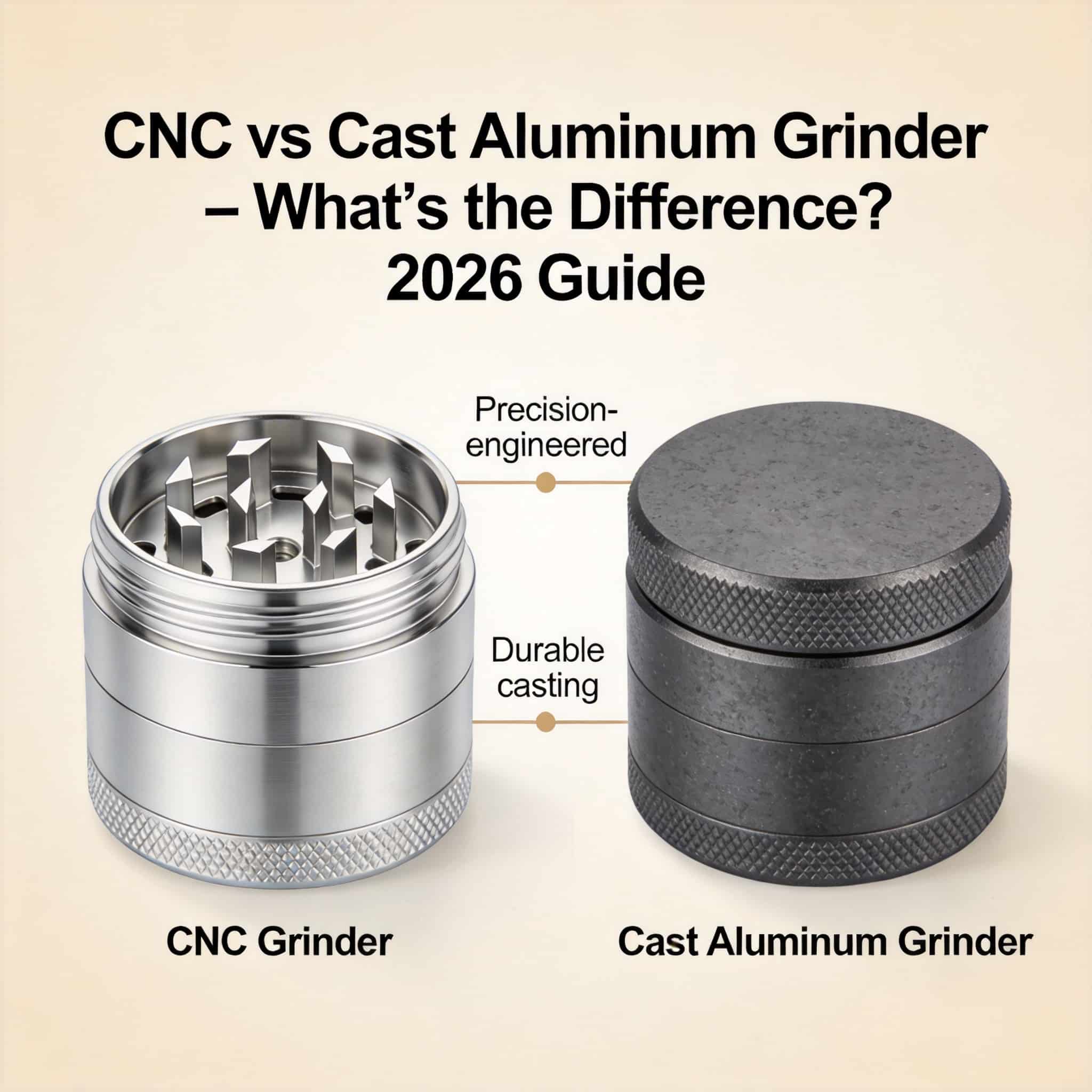
If you’re shopping for a premium weed grinder in 2026, you’ve likely seen the terms CNC machined aluminum and cast aluminum.
They sound similar.
They are not.
The difference affects:
- Durability
- Thread smoothness
- Tooth precision
- Long-term wear
- Overall feel
Let’s break down exactly how CNC and cast aluminum grinders compare — and which one makes more sense for serious daily use.
What Is a CNC Machined Grinder?
CNC stands for Computer Numerical Control.
A CNC grinder is made by cutting a solid block of aluminum using precision-controlled machining tools. Every tooth, thread, and surface is carved to exact tolerances.
Characteristics of CNC Machined Grinders:
✔ Made from solid aluminum billet
✔ Tight machining tolerances
✔ Smooth thread engagement
✔ Clean tooth geometry
✔ Minimal warping
✔ High structural strength
Because the part is cut rather than poured, the final piece maintains uniform density and strength throughout.
What Is a Cast Aluminum Grinder?
Casting involves melting aluminum and pouring it into a mold.
Once cooled, the part is removed and finished with additional machining for threads and surface finishing.
Characteristics of Cast Aluminum Grinders:
✔ Mold-based production
✔ Lower manufacturing cost
✔ Faster bulk production
✔ More porous metal structure
✔ Potential surface inconsistencies
Casting is common in lower to mid-tier grinders because it reduces production cost.
Strength & Structural Integrity
CNC Machined Aluminum
When aluminum is machined from a solid billet:
- Grain structure remains tight
- Density is consistent
- Structural strength is higher
- Resistance to cracking is improved
This matters for:
- Thread durability
- Drop resistance
- Long-term tooth wear
Cast Aluminum
Casting introduces:
- Potential air pockets
- Micro-porosity
- Slight variations in density
While many cast grinders perform adequately, over time they can be more prone to:
- Thread wear
- Minor warping
- Structural fatigue
Especially under heavy daily use.
Threading Precision
Thread smoothness is one of the most noticeable differences.
CNC Threads
CNC machining allows for:
- Tighter tolerances
- Cleaner cuts
- More precise alignment
This results in:
- Smoother lid engagement
- Less cross-threading
- More consistent feel
Cast Threads
In cast grinders:
- Threads are often machined after casting
- Variations in the cast body can affect alignment
- Over time, wear can become noticeable
You may experience:
- Gritty engagement
- Slight wobble
- Faster thread degradation
Tooth Geometry & Grind Consistency
Tooth shape directly affects:
- Flower texture
- Airflow
- Resistance to clogging
CNC machining allows:
- Sharper tooth edges
- More consistent spacing
- Tighter alignment
Cast grinders can still function well, but the tolerances between teeth may vary slightly due to mold limitations.
For daily users, grind consistency becomes noticeable over months of use.
Surface Finish & Anodizing
Both CNC and cast grinders can be anodized.
However:
CNC parts tend to anodize more uniformly because the metal density is consistent.
Cast aluminum can sometimes show slight surface variations due to micro-porosity.
Over time, higher-density metal typically maintains finish integrity better.
Weight & Feel
CNC grinders often feel:
- More solid
- More balanced
- Tighter when assembled
Cast grinders may feel slightly lighter or less rigid depending on alloy mix and wall thickness.
This isn’t always dramatic — but side-by-side comparisons usually reveal the difference.
Cost Differences
Casting is cheaper to manufacture.
CNC machining requires:
- More time
- More tooling
- Higher equipment cost
- More labor precision
That’s why CNC grinders usually sit in the premium price tier.
You’re paying for precision and durability.
Longevity Comparison
CNC Machined Aluminum
Expected lifespan under daily use:
Several years with minimal performance loss.
Cast Aluminum
Expected lifespan under daily use:
Often shorter, depending on alloy quality and usage habits.
This doesn’t mean cast grinders are “bad.”
It means they’re generally built for lower manufacturing cost, not maximum lifespan.
Which Should You Choose?
Choose CNC if you:
✔ Want long-term durability
✔ Use your grinder daily
✔ Care about thread smoothness
✔ Prefer tight machining tolerances
✔ Value structural integrity
Choose cast aluminum if you:
✔ Want a lower upfront price
✔ Use your grinder occasionally
✔ Are less concerned with long-term wear
Final Verdict
The difference between CNC and cast aluminum grinders comes down to:
Precision
Durability
Machining tolerance
Long-term performance
For serious daily users who want smooth threads, consistent grind texture, and multi-year durability, CNC-machined aluminum typically delivers a higher-end experience.
For casual or budget-focused buyers, cast aluminum may meet expectations at a lower cost.
Understanding the difference allows you to choose intentionally — not just based on marketing terms.