
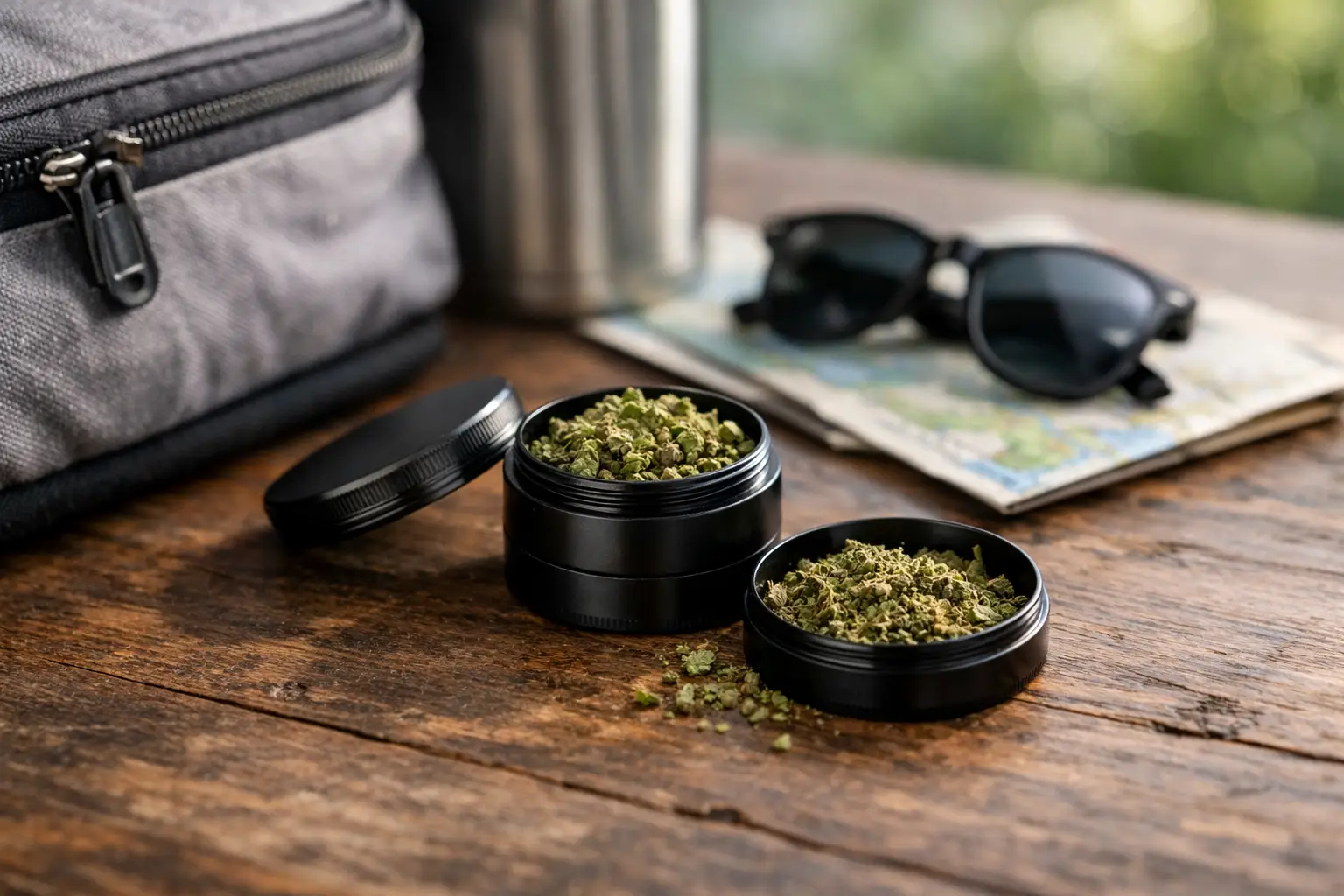
A grinder that works great at home can be a headache the second it leaves the coffee table. It starts rattling around in a bag, picking up lint, spilling ground herb, or jamming when you need a quick, clean prep. If you’re shopping for a compact weed grinder for travel, size matters, but it is not the whole story. The better question is whether that smaller grinder still performs like a serious tool.
That is where a lot of travel grinders fall apart. Too many compact models are built like novelty accessories – light, cheap, and easy to carry, but inconsistent once you actually use them. Teeth dull faster, lids loosen up, and the grind gets fluffy in one spot and chunky in another. A travel grinder should not ask you to trade away performance just because it takes up less space.
What a compact weed grinder for travel actually needs
A compact grinder has one job on the road: keep your setup simple without creating new problems. That means it needs to fit easily in a small pouch, glove box, backpack pocket, or travel case while still grinding evenly enough for a clean burn, smooth roll, or efficient pack.
The first requirement is stable construction. If the body flexes or the lid fit is sloppy, smaller size becomes a liability. Compact grinders already give you less leverage than oversized models, so every part has to be more precise, not less. Tight tolerances matter more in a travel grinder because there is less room for error. A cheap unit can feel fine in your hand when it is empty, then bind up as soon as sticky flower hits the teeth.
Material matters just as much. Plastic is light, but it wears fast and usually feels worse with every use. Low-grade metal can chip, strip, or develop rough threading. A well-machined aluminum grinder hits the right balance for travel. It stays light enough to carry comfortably, but strong enough to handle regular use without turning into a disposable accessory.
Then there is closure. This is one of the biggest differences between a grinder designed for serious use and one designed to look good in a listing photo. For travel, a secure top is not optional. Loose lids and rough threads are a bad match for movement. A magnetic closure or another well-controlled fit helps keep the grinder shut, keeps herb where it belongs, and makes the overall experience cleaner.
Small does not mean weak
A lot of buyers assume compact means entry-level. It does not have to. The best smaller grinders are scaled-down versions of full-performance tools, not stripped-down versions of cheap ones.
That means the tooth pattern still matters. The shape, spacing, and alignment of the teeth directly affect your grind consistency. If the teeth are poorly cut or randomly arranged, the grinder can shred one section of flower while barely touching another. You end up rotating longer, applying more pressure, and getting a result that is harder to smoke evenly.
A properly engineered compact grinder should still produce a consistent texture with minimal effort. That matters if you roll, pack bowls, or use dry herb devices and want predictable airflow. It also matters if you are grinding in less-than-ideal conditions – outside, in a parked car, at a campsite, or anywhere you do not want to spend five extra minutes fighting your gear.
The smaller the grinder, the more every design choice has to pull its weight. Good machining is not a luxury feature here. It is what keeps the tool usable.
2-piece, 3-piece, or 4-piece for travel?
This is where personal preference really comes into play. There is no single best configuration for every travel setup, but there is a clear trade-off between simplicity and storage.
A 2-piece grinder is usually the cleanest travel option. It is compact, straightforward, and easy to empty. If you want the lowest-profile setup possible, this is often the move. Fewer parts mean less bulk and less to clean, and that makes a difference when you are carrying only the essentials.
A 3-piece grinder gives you a little more flexibility because it separates ground herb into a lower chamber. That can be useful when you want to grind ahead without immediately using everything. For travel, that added storage can be convenient, but it also adds height.
A 4-piece grinder offers the most separation, including a kief chamber, but it is not always the smartest travel choice. If your priority is maximum portability, four-piece designs can feel taller and slightly less pocket-friendly. On the other hand, if you travel often and want a more complete setup in one unit, the extra chamber may be worth it.
The right answer depends on how you actually use your grinder. If you prep small amounts and value a minimal kit, 2-piece makes sense. If you like storage and separation, a 3-piece or 4-piece may justify the extra size. What matters is choosing a configuration that matches your habits instead of assuming more chambers always mean a better grinder.
The details that make travel easier
The biggest difference between a grinder you tolerate and a grinder you rely on usually comes down to small engineering details. For travel, those details show up fast.
Weight is one of them. You want enough mass that the grinder feels solid, but not so much that it becomes dead weight in a bag or pocket. A compact grinder should feel dense and precise, not bulky. Good aluminum construction helps hit that middle ground.
Grip is another factor buyers overlook. If the edge profile is too slick, opening and rotating the grinder gets annoying, especially if your hands are dry, cold, or sticky. A travel grinder should be easy to operate without needing a perfect setup.
Cleaning also matters more than people think. Travel creates more opportunities for residue buildup because your grinder gets used in different environments and may sit closed longer between sessions. A design that resists clogging and opens smoothly after repeated use is worth paying for.
And then there is noise. It sounds minor until you carry a grinder in a backpack every day. A loose, rattly grinder feels cheap because it is cheap. A well-built one stays tight, stays quiet, and feels controlled.
Why cheap travel grinders disappoint so fast
There is a reason bargain grinders keep getting replaced. They are built to win on price and size, not long-term use. On paper, they check the box. In practice, they start failing where it counts.
The most common issue is inconsistent machining. Threads feel rough. Teeth wear down. The lid fit gets worse over time. Herb starts catching in places it should not, and suddenly your “compact” grinder is taking more effort than a larger, better-built one ever would.
That is why serious buyers pay attention to manufacturing, not just appearance. When a grinder is machined with tighter tolerances and better materials, you feel it immediately. Rotation is smoother. Fit is cleaner. Performance stays consistent. That matters even more in a smaller format because compact grinders have less room to hide flaws.
At Tahoe Grinder Co, that performance-first mindset is the entire point. A grinder should feel like a precision tool, not a throwaway accessory that happens to fit in your pocket.
How to choose the right one without overthinking it
Start with your real use case. If you want something for a weekend bag or glove box, keep it simple and prioritize compact dimensions, secure closure, and grind consistency. If you use your grinder daily while commuting or traveling, step up your standards on machining quality and durability because the wear adds up fast.
Next, think about your flower. Sticky, dense material exposes weak grinders immediately. If you regularly grind fresher herb, avoid anything that looks flimsy or overly light. A compact grinder still needs enough structural integrity to cut cleanly instead of mash and smear.
Finally, buy for longevity. A travel grinder gets knocked around more than a home grinder. It gets dropped into bags, carried between sessions, and used in less controlled environments. That is exactly why quality matters. The best compact model is not the smallest one you can find. It is the one that still works like new after months of real use.
A compact weed grinder for travel should make your setup easier, not more compromised. When the machining is right, the material is right, and the design is built for actual use, smaller becomes smarter. Buy the one that earns space in your bag every single time.