
Most weed grinders look similar on the outside.
What separates a high-quality grinder from a disposable one is how it’s made, not how it’s advertised.
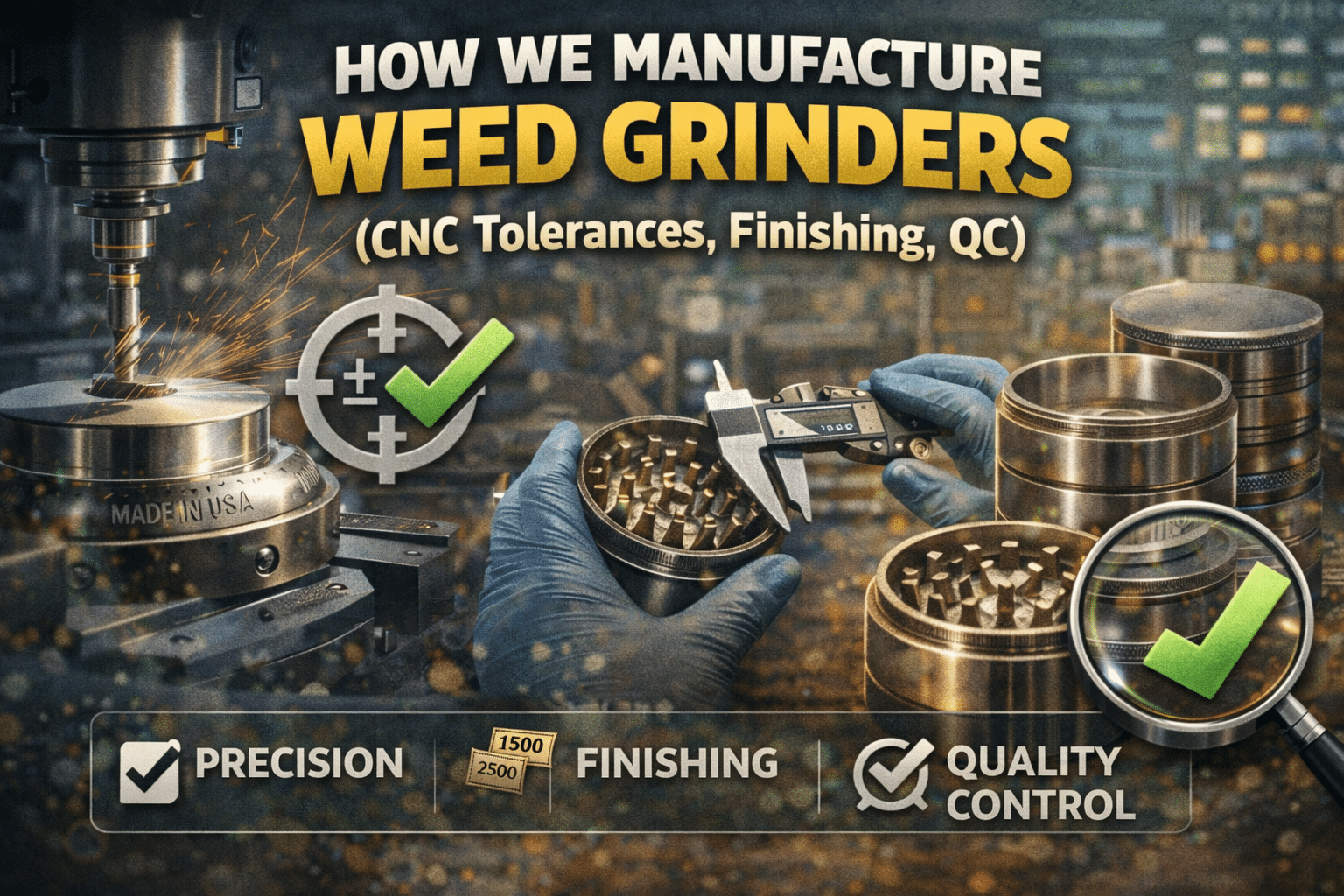
This guide explains how we manufacture our weed grinders, focusing on:
- CNC machining tolerances
- Tooth geometry and alignment
- Surface finishing
- Magnet and fitment precision
- Quality control at every stage
No buzzwords. Just the process.
It Starts With Solid Material (Not Cast Scrap)
We manufacture our grinders from solid aluminum stock, not cast or pot-metal blanks.
Why that matters:
- Cast grinders have inconsistent density
- Internal voids weaken structure
- Threads and teeth wear unevenly
- Tolerances drift quickly over time
Solid billet aluminum machines predictably and holds tight tolerances — which is the foundation for everything that follows.
You can see the grinders built using this process here:
https://tahoegrinderco.com/product-category/all-products/
CNC Machining: Where Quality Is Won or Lost
All critical grinder components are CNC-machined, not stamped or molded.
What CNC Machining Controls
- Tooth geometry
- Tooth height and spacing
- Chamber concentricity
- Flatness of mating surfaces
- Magnet pocket depth
- Thread pitch and alignment (where applicable)
Every one of these affects:
- Grind consistency
- Airflow
- Resin buildup
- Long-term durability
CNC Tolerances: Why Thousandths Matter
We machine grinder components to tight tolerances, measured in thousandths of an inch.
Why this matters in real use:
- Loose tolerances = wobble, binding, uneven grind
- Tight tolerances = smooth rotation, clean cuts
If tolerances are off by even a small amount:
- Teeth don’t align properly
- Flower tears instead of slicing
- Fines increase
- Resin smears instead of separating
That’s how grinders become dusty, sticky, and frustrating.
Tooth Design: Cut, Don’t Shred
Tooth design is one of the most misunderstood parts of grinder manufacturing.
We focus on:
- Cutting angle
- Edge sharpness
- Tooth spacing
- Engagement depth
Our teeth are designed to slice flower cleanly, not pulverize it.
This produces:
- A fluffy, consistent grind
- Better airflow
- Less dust
- Less resin buildup
Overly aggressive teeth look impressive but destroy structure and clog devices downstream.
This is why our grinders work especially well for bowls and pipes, including glass like:
https://tahoegrinderco.com/product-category/all-products/glass-pipes-bongs-dab-rigs/pipes/
Chamber Design & Alignment
Each chamber is machined to remain concentric — meaning all rotating parts stay centered around the same axis.
Poor alignment causes:
- Grinding resistance
- Uneven tooth engagement
- Binding under load
- Accelerated wear
Proper alignment ensures:
- Smooth rotation
- Even force distribution
- Consistent output
This matters even more in larger-diameter grinders, where leverage magnifies any misalignment.
Threaded vs Threadless: Machining Differences
Threaded Grinders
Threaded grinders require:
- Precisely cut thread pitch
- Clean lead-in chamfers
- Tight but non-binding tolerances
Threads are machined — not rolled — to prevent:
- Cross-threading
- Resin lock
- Premature wear
Threaded designs are most common in multi-chamber grinders, including:
https://tahoegrinderco.com/product-category/all-products/4-piece-weed-grinders/
Threadless Grinders
Threadless grinders rely entirely on:
- Flatness of mating surfaces
- Magnet strength and placement
- Dimensional consistency
There’s zero forgiveness here — if tolerances are off, the grinder won’t stay aligned.
This is why threadless grinders demand more precise machining, not less.
You’ll most often see threadless designs in simpler formats like:
https://tahoegrinderco.com/product-category/all-products/2-piece-weed-grinders/
Magnet Installation & Retention
Magnets are press-fit into precision-cut pockets.
Critical factors:
- Pocket depth
- Magnet polarity alignment
- Press force
Too loose:
- Magnet shifts or falls out
Too tight:
- Cracks surrounding material
Correct magnet placement:
- Keeps chambers aligned
- Prevents separation during grinding
- Improves one-handed use
This is not cosmetic — it’s functional.
Surface Finishing: More Than Looks
After machining, components go through surface finishing.
This process:
- Removes micro-burrs
- Smooths internal surfaces
- Reduces resin adhesion
- Improves cleanability
A smoother internal finish:
- Smells less when empty
- Cleans faster
- Builds less residue over time
Cheap grinders skip proper finishing — which is why they feel gritty and smell even when “clean.”
Screen Installation (4-Piece Grinders)
For grinders with kief catchers, screen quality matters.
We focus on:
- Consistent mesh size
- Proper screen tension
- Flat, even seating
Poor screen installation causes:
- Uneven kief separation
- Plant matter contamination
- Premature clogging
This is one reason not all 4-piece grinders collect kief equally — even when they look similar.
See multi-chamber grinders here:
https://tahoegrinderco.com/product-category/all-products/4-piece-weed-grinders/
Quality Control: Every Grinder, Not Samples
Quality control isn’t a final step — it’s layered.
QC Checks Include:
- Dimensional verification
- Chamber fit and alignment
- Rotation smoothness
- Magnet retention
- Thread engagement (if applicable)
- Visual inspection for burrs or defects
Grinders that don’t meet spec don’t ship.
This is how consistency is maintained across production runs.
Why Manufacturing Quality Matters to You
All of this translates directly to real-world use.
Better manufacturing means:
- Fluffier grind
- Better airflow
- Less clogging
- Less smell retention
- Easier cleaning
- Longer lifespan
A grinder isn’t just a container — it’s a mechanical cutting tool.
If it’s built poorly, no amount of marketing fixes that.
Final Takeaway: Precision Is the Product
Anyone can make a grinder that looks good.
Manufacturing a grinder that:
- Cuts cleanly
- Feels smooth years later
- Doesn’t bind or stink
- Holds tolerances over time
…requires precision at every step.
That’s what CNC machining, proper finishing, and real QC deliver — and why our grinders perform the way they do.
Browse grinders built with this process here:
https://tahoegrinderco.com/product-category/all-products/