
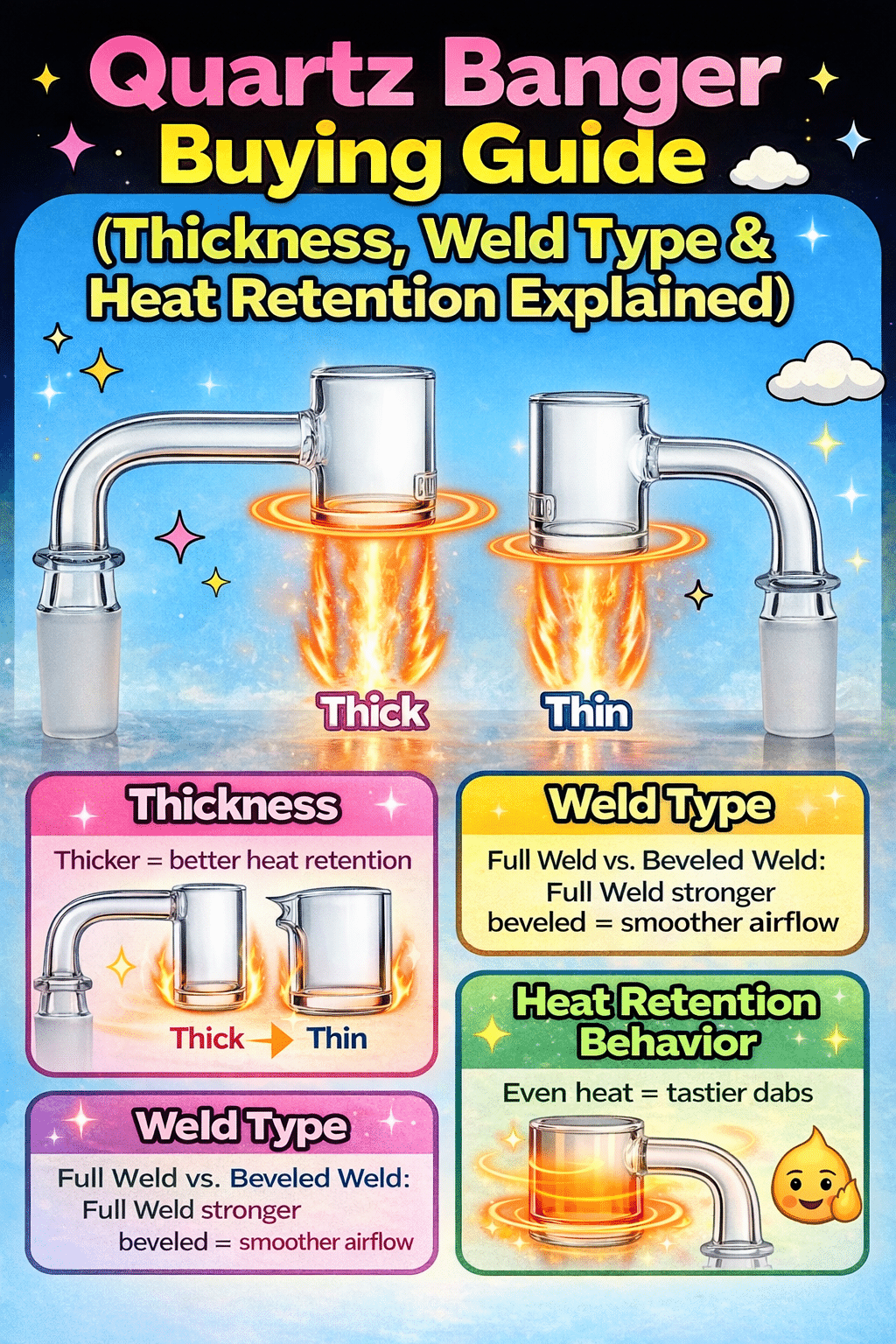
(Thickness, Weld Type & Heat Retention Explained)
A quartz banger looks simple, but small design differences dramatically affect how your dabs taste, how long heat lasts, and how forgiving your setup is.
Most people buy bangers based on appearance or price. That’s why they end up with scorched flavor, inconsistent vapor, or constant reheating. In reality, banger performance is dictated by three things:
- Thickness
- Weld type
- Heat retention behavior
Understand these, and you’ll never buy the wrong banger again.
Why Quartz Is the Standard
Quartz dominates dabbing because it:
- Handles high heat safely
- Doesn’t retain flavor
- Heats predictably
- Cools at a controllable rate
Not all quartz is equal — but good quartz behaves consistently under thermal stress.
Thickness: The Single Most Important Factor
Thickness determines how heat is stored, distributed, and released.
Thin Bangers (1.5–2mm)
Characteristics
- Heat up quickly
- Cool very fast
- Extremely unforgiving
Pros
- Fast heat cycles
- Cheap
Cons
- Easy to overheat
- Poor heat retention
- Scorches terpenes
- Requires constant reheating
Thin bangers are beginner traps. They look fine, but perform poorly.
Medium Thickness (2.5–3mm) — Sweet Spot
Characteristics
- Balanced heat-up time
- Controlled cooling
- Predictable vapor window
Pros
- Great flavor
- Easier temp control
- Works well with carb caps
- Ideal for most users
Cons
- Slightly higher cost
This is the most versatile thickness for daily use.
Thick / Thermal Bangers (4mm+)
Characteristics
- Hold heat for a long time
- Very stable temperature
- Forgiving for beginners
Pros
- Excellent heat retention
- Longer low-temp window
- Great for large dabs
- Less reheating
Cons
- Longer heat-up
- Easier to overcook if overheated
- More expensive
Thick bangers reward restraint. Overheating ruins the advantage.
Bottom Thickness vs Wall Thickness (Important Distinction)
Many listings mention thickness without clarity.
- Bottom thickness affects heat retention most
- Wall thickness affects airflow and stability
A thick bottom with moderate walls is ideal. Ultra-thick walls add weight without much benefit.
Weld Type: Why It Matters More Than It Sounds
The weld connects the bucket to the joint — and it’s a major stress point.
Seamless (One-Piece) Bangers
What it means
The bucket and joint are formed from a single piece of quartz.
Pros
- Strongest structure
- Best heat distribution
- No weak points
- Clean aesthetics
Cons
- Higher cost
- Harder to manufacture
Seamless bangers are the gold standard.
Welded Bangers
What it means
The bucket is fused to the joint.
Pros
- More affordable
- Widely available
Cons
- Weld area concentrates stress
- Heat distribution is uneven
- More prone to cracking at the joint
Good welds can last years. Bad welds fail quickly.
Why Weld Quality Matters
Poor welds cause:
- Stress fractures
- Heat loss at the joint
- Cracking after repeated cycles
If you see cloudy welds, uneven seams, or excess material — that’s a red flag.
Heat Retention: What Actually Controls It
Heat retention isn’t just thickness.
It depends on:
- Quartz purity
- Bottom mass
- Surface finish
- Banger geometry
- Carb cap efficiency
Thickness helps — but design determines how usable that heat is.
Flat Bottom vs Thermal Core Designs
Flat Bottom Bangers
- Simple
- Easy to clean
- Reliable
- Great with directional or bubble caps
Best all-around choice.
Thermal / Double Wall Bangers
- Inner chamber retains heat
- Outer wall insulates
- Longer vapor window
Excellent for low-temp dabs but:
- Harder to clean
- Easier to overheat
- More sensitive to technique
Joint Angle and Fitment (Don’t Ignore This)
Common angles:
- 90°
- 45°
Wrong angle causes:
- Poor airflow
- Awkward carb cap fit
- Heat imbalance
Always match the banger angle to your rig.
Bucket Diameter & Depth
Wide Buckets
- Better for pearls
- Easier airflow
- Even heat spread
Deep Buckets
- Hold larger dabs
- Increase heat retention
- Require better carb cap control
Choose based on dab size and style.
Quartz Quality: Clear vs Cloudy
Clear quartz:
- Indicates higher purity
- Better heat behavior
- Less devitrification
Cloudy quartz:
- Heats unevenly
- Degrades faster
- Loses clarity with use
Clouding after use is normal — initial cloudiness is not.
Why Cheap Quartz Fails
Low-cost bangers often fail because:
- Impure quartz
- Poor welds
- Inconsistent thickness
- Weak stress handling
They work — briefly — then crack, scorch, or lose performance.
Beginner-Friendly Quartz Banger Checklist
If you want a safe buy:
✔ 2.5–4mm bottom thickness
✔ Flat bottom design
✔ Seamless or clean weld
✔ Clear quartz
✔ Correct joint angle
✔ Compatible carb cap
This setup gives the widest margin for error.
Common Buying Mistakes
- Buying thin bangers to save money
- Overheating thick bangers
- Ignoring weld quality
- Mismatching carb caps
- Using pearls without airflow control
Most bad dabs start with a bad banger choice.
Cleaning & Longevity Notes
Even the best banger fails if abused.
- Don’t torch red hot repeatedly
- Clean after every session
- Avoid thermal shock
- Let cool before rinsing
Heat management extends lifespan more than price.
Final Takeaway
A quartz banger is not just a container — it’s a thermal system.
Thickness controls how heat is stored.
Weld type controls durability.
Design controls how heat is used.
The best banger isn’t the thickest or the flashiest — it’s the one that:
- Holds heat predictably
- Distributes it evenly
- Matches your rig and carb cap
- Forgives small mistakes
Understand those principles, and every dab gets smoother, tastier, and more efficient — without chasing gimmicks.