
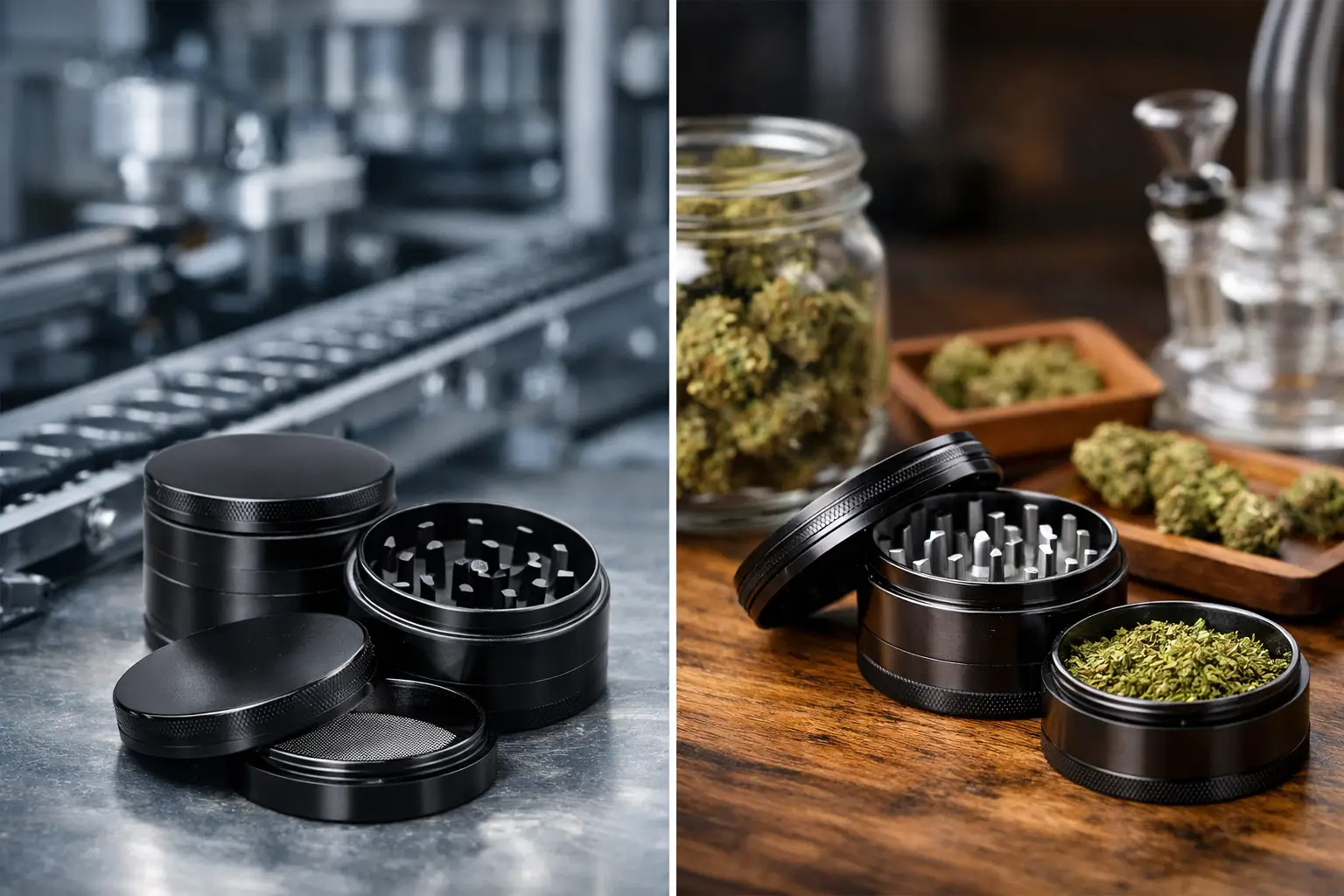
A factory direct vs smoke shop grinder decision looks simple until a cheap grinder starts binding, its teeth dull, or the lid cross-threads after a few weeks of regular use. At that point, the price tag that looked like a deal becomes irrelevant. A grinder is a working tool, and the real question is whether it was built for repeated use or merely stocked to fill a display case.
For adult cannabis consumers who care about a clean, consistent prep experience, the difference is usually found in the details: material grade, machining accuracy, tooth geometry, lid design, quality control, and accountability after the sale. A local smoke shop can be convenient. Buying direct from the manufacturer can be the smarter long-term move when the product is engineered, inspected, and backed by the people who made it.
Factory Direct vs Smoke Shop Grinder: The Real Difference
A smoke shop is typically a retailer. It buys inventory from distributors or brands, puts products on the shelf, and sells a range of accessories at different price points. That model has one obvious advantage: you can walk in, hold a grinder, and leave with it immediately.
The trade-off is that the shop may not know who machined the grinder, what aluminum alloy was used, how the teeth were cut, or whether the finish will hold up. Many grinders arrive at retail through layers of distributors, importers, and private-label suppliers. Two different logos can sit side by side while coming from the same anonymous production run.
Factory direct is different when the manufacturer actually controls production. The company designs the product, selects the material, programs the CNC machines, manages finishing and assembly, inspects the parts, and ships the finished grinder directly to the buyer. That control creates a much tighter connection between the tool you use and the people responsible for its performance.
It also removes a common weak point: the handoff. When a retailer only sells a grinder, product questions, warranty claims, and replacement decisions can become someone else’s problem. A true manufacturer has nowhere to pass the buck.
What You Are Actually Paying For
The best grinder is not defined by how many colors it comes in or how aggressive its teeth look through plastic packaging. Performance comes from engineering decisions that are difficult to judge at a glance.
Material matters more than weight
A heavy grinder is not automatically a strong grinder. Some low-cost models feel substantial because they use thick, low-grade metal or cheap zinc alloys. Those materials can wear, chip, corrode, or leave a rough finish around the teeth and threads.
Premium aluminum grinders are built from aluminum chosen for strength, machinability, and long-term resistance to everyday use. 6061-T6 aluminum is a serious material for a serious tool. It delivers the durability customers expect without turning a pocket-sized accessory into a brick.
The better question is not, “Does it feel heavy?” It is, “What is it made from, and was it machined with intention?” A manufacturer that can answer that clearly is already giving you more information than a generic retail shelf tag.
Precision machining changes the daily experience
A grinder works through contact. Teeth meet herb. The lid meets the body. Threads or magnets align chambers. Screens sit in their recesses. When those surfaces are cut loosely, the grinder feels loose too. It may wobble, scrape, seize, or produce an inconsistent texture.
CNC machining allows a manufacturer to hold tight tolerances across every component. That means teeth are cut cleanly, mating surfaces fit correctly, and the grinder opens and closes the way it should. It is the difference between forcing a tool to work and using one that feels right every time you pick it up.
Thread-less magnetic designs are a strong example. Traditional threaded lids can collect residue, cross-thread, and become frustrating when they bind. A properly designed magnetic lid removes that failure point while keeping the grinder secure and quick to access. It is not a gimmick. It is a practical improvement to a part of the tool you touch constantly.
Tooth design is about consistency, not spectacle
Oversized, jagged teeth may look impressive, but they are not automatically better at processing dried herb. The goal is a consistent, usable grind with less tearing, crushing, and wasted effort. Well-designed teeth guide material through the chamber instead of compacting it into a frustrating knot.
That consistency matters whether you are packing a bowl, filling a paper, loading a dry herb vaporizer, or preparing a larger session. Fine control over texture makes the rest of the experience easier. A grinder that produces random chunks one day and powder the next is not doing its job.
When a Smoke Shop Grinder Makes Sense
There is a place for the local smoke shop. If your old grinder failed midweek and you need a replacement today, a nearby shop solves an immediate problem. Stores can also be useful for comparing sizes in person, especially if you are deciding between a compact carry grinder and a larger model for home use.
A smoke shop purchase can work if the shop carries a known manufacturer, provides clear product information, and stands behind what it sells. The issue is not that every shop grinder is bad. The issue is that retail shelves often make it harder to separate a purpose-built tool from a generic accessory with premium-looking packaging.
If you buy from a shop, inspect the grinder before you leave. Check whether the lid seats evenly, whether the chambers align smoothly, whether the teeth have clean edges, and whether the finish looks uniform. Ask what material it is made from and who handles warranty support. Vague answers are useful answers – they tell you what you need to know.
Why Direct Buying Favors the Long Game
Buying factory direct gives you a clearer line of sight into the product. You can compare chamber configurations, diameters, finishes, and design features from the source rather than relying on whatever happened to be ordered for a store display.
That matters because there is no universal “best” grinder size or configuration. A two-piece grinder is simple, compact, and fast for users who want a straightforward grind-and-go tool. A three-piece model adds storage space below the teeth. A four-piece grinder adds a screen and lower chamber for people who prefer that setup. Larger grinders, including 90mm options, make sense for people preparing more herb at once, while compact sizes are easier to carry.
Direct manufacturers are also positioned to offer a broader catalog without forcing a retailer to devote shelf space to every variation. You choose based on how you use your grinder, not on which colors and sizes were left in the case.
Then there is the warranty. A lifetime warranty is more than a marketing line when it comes from the company that machines and ships the product. It signals that the manufacturer expects its material, finish, and construction to outlast the disposable-grinder cycle. Tahoe Grinder Co builds its grinders in-house in the USA because control over the process is what allows that kind of confidence.
The Cost Per Use Is the Better Math
A bargain grinder can cost less at checkout and still cost more over time. If it jams, loses teeth, develops rough threads, or gets replaced every year, the low entry price stops being a bargain. Add the annoyance of inconsistent grinding and the value gap gets wider.
A premium factory-direct grinder costs more because the inputs cost more: better aluminum, CNC machine time, finishing, inspection, and support. But a tool that performs reliably for years has a lower cost per use than an accessory that repeatedly fails. More importantly, it removes one more point of friction from a routine that should be simple.
This does not mean every buyer needs the largest or most feature-packed model. It means buying the right configuration once is usually better than cycling through whatever is cheapest at the counter.
How to Make the Right Call
Start with the manufacturer, not the logo. Look for specifics about where the grinder is made, what material is used, and how it is constructed. Then match the grinder to your use: compact for portability, larger diameter for volume, fewer chambers for simplicity, or a multi-piece setup for more separation and storage.
Finally, ask the ownership question: if something goes wrong, who is responsible? If that answer is unclear, the grinder is probably not built around long-term ownership.
A local shop can handle today’s emergency. A well-made factory-direct grinder is the move for everyone tired of treating an essential cannabis tool like a disposable accessory.