
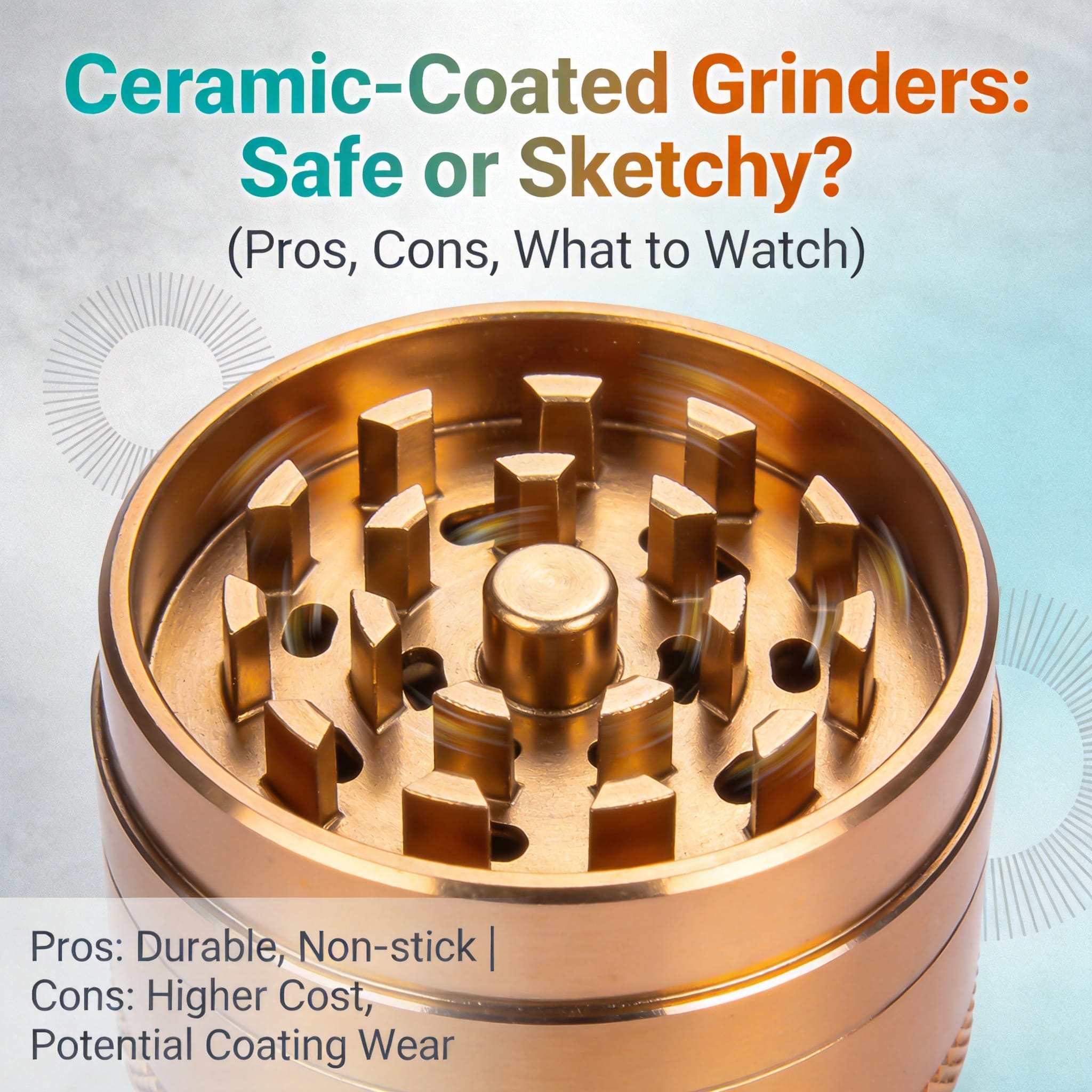
Ceramic-coated weed grinders are everywhere right now. They’re usually marketed as non-stick, easy to clean, and premium. On paper, that sounds perfect—especially if you’ve dealt with sticky weed, clogged teeth, or grinders that smell forever.
But ceramic coatings sit in a weird gray zone.
Some are legitimately well-executed.
Many are purely cosmetic.
And a large number fall somewhere between fine at first and problematic over time.
This article breaks down what ceramic-coated grinders actually are, when they make sense, when they don’t, and how to tell the difference between a safe implementation and a sketchy one.
No hype. No fear-mongering. Just real-world behavior.
What “Ceramic-Coated” Actually Means
First, an important clarification:
A ceramic-coated grinder is not a ceramic grinder.
It is almost always:
- A metal grinder
- With a thin ceramic layer applied to the surface
That base metal matters more than the coating itself.
Most ceramic-coated grinders use:
- Aluminum as the substrate
- Occasionally zinc alloy (this is where problems start)
The ceramic layer is applied afterward to reduce friction and improve cleanability.
Why Ceramic Coatings Exist at All
Ceramic coatings are attractive because they promise to solve real problems:
- Resin sticking to teeth
- Difficult cleaning
- Odor retention
- Sticky rotation with high-terpene flower
A well-applied ceramic layer can reduce surface friction and slow resin buildup—at least initially.
That’s the upside.
The Pros of Ceramic-Coated Grinders
Let’s give credit where it’s due.
✅ Reduced Initial Stickiness
Fresh ceramic surfaces are slick. Sticky flower doesn’t smear as quickly, especially during the first few months of use.
✅ Easier Short-Term Cleaning
Resin doesn’t bond as aggressively to ceramic as it does to raw metal or painted finishes.
✅ Smooth Feel Out of the Box
New ceramic grinders often feel extremely smooth during rotation.
That’s why they impress early users.
The Cons (And Why They Matter Long-Term)
This is where reality kicks in.
❌ Ceramic Is a Surface Treatment, Not Structural
Ceramic coatings do not add strength to the grinder. They do not improve alignment. They do not fix poor machining.
If the grinder underneath is poorly made, ceramic just hides it temporarily.
❌ Coating Wear Is Inevitable
All ceramic coatings wear over time.
Grinding involves:
- Constant metal-to-metal contact
- Pressure on tooth edges
- Resin abrasion
When ceramic wears:
- It wears unevenly
- High-contact points lose coating first
- Bare metal becomes exposed
At that point, performance changes—and not for the better.
❌ Mixed-Surface Grinding Is a Problem
Once ceramic wears unevenly, you now have:
- Ceramic-on-ceramic contact in some areas
- Ceramic-on-metal contact in others
- Metal-on-metal contact elsewhere
This inconsistency leads to:
- Uneven grind texture
- Changes in resistance
- Increased binding over time
That’s not something most marketing mentions.
The Biggest Red Flag: Ceramic on Zinc
Here’s where things cross from “meh” to avoid entirely.
If a ceramic-coated grinder is made from zinc alloy, it’s a hard no.
Why?
- Zinc is usually die-cast, not machined
- Casting creates porous surfaces
- Ceramic coatings rely on good surface bonding
- Once ceramic chips, raw zinc is exposed
At that point, the coating is doing more harm than good.
This is especially common in flashy, low-cost grinders sold online:
https://tahoegrinderco.com/product-category/all-products/
Ceramic vs Anodized Aluminum (Important Distinction)
A lot of people confuse ceramic coatings with anodizing. They are not the same.
Anodized Aluminum
- Electrochemical process
- Becomes part of the metal
- Cannot flake or peel
- Food-grade and inert
- Wears evenly over time
Ceramic Coating
- Applied surface layer
- Can chip or wear unevenly
- Depends heavily on application quality
This is why many premium grinders still rely on anodized aluminum instead of ceramic:
https://tahoegrinderco.com/product-category/all-products/2-piece-weed-grinders/
How to Tell If a Ceramic Grinder Is Well-Made
If you’re considering one, here’s what actually matters.
1. What’s the Base Metal?
If it doesn’t explicitly say aluminum alloy, walk away.
Avoid anything vague like:
- “Premium metal”
- “Alloy body”
- “Heavy-duty construction”
2. Look at Tooth Geometry
Ceramic grinders with:
- Sharp, well-defined teeth
- Visible machining lines
- Crisp edges
Are far more likely to perform well long-term than smooth, rounded, cast teeth.
3. Check Wear Zones
High-quality ceramic coatings will:
- Be thicker at tooth roots
- Show uniform finish
- Avoid thin, glossy paint-like appearance
Ultra-shiny ceramic often means thin coating.
Ceramic Grinders and Multi-Chamber Designs
Ceramic coatings tend to struggle more in:
- 4-piece grinders
- Grinders with screens
- Designs with lots of internal contact points
Once coating wears on threads or screens, maintenance becomes harder, not easier.
That’s why many daily users prefer proven aluminum designs for multi-chamber setups:
https://tahoegrinderco.com/product-category/all-products/3-piece-weed-grinders/
https://tahoegrinderco.com/product-category/all-products/4-piece-weed-grinders/
Cleaning Ceramic-Coated Grinders (What NOT to Do)
Ceramic coatings are more sensitive to cleaning than anodized aluminum.
Avoid:
- Abrasive brushes
- Metal picks
- Harsh scraping
- Aggressive ultrasonic cleaning
Once scratched, ceramic does not “heal.”
That scratch becomes a wear initiation point.
Are Ceramic-Coated Grinders Unsafe?
This is the honest answer:
A well-made ceramic-coated aluminum grinder is generally safe, especially early in its lifespan.
A cheap ceramic-coated zinc grinder is not something you want long-term.
The risk isn’t immediate catastrophe — it’s gradual degradation, flaking, and inconsistent performance.
Why We Don’t Rely on Ceramic Coatings
At Tahoe Grinder Co., we don’t rely on ceramic coatings to fix problems.
Instead, we focus on:
- Precision machining
- Controlled aluminum alloys
- Food-grade anodized finishes
- Consistent tolerances
Because a grinder that’s designed correctly doesn’t need a gimmick layer to work well:
https://tahoegrinderco.com/product-category/all-products/square-grinders/
Final Verdict: Ceramic Is Optional, Not Essential
Ceramic-coated grinders are not inherently dangerous — but they are not a magic solution.
They:
- Can feel great at first
- Require more care over time
- Depend heavily on base material and application quality
If you understand what you’re buying and why, they can work.
If you’re buying purely on buzzwords like non-stick ceramic, that’s where people get burned.
In grinders, design and material always outlast coatings.
And that’s the difference between something that looks smooth on day one—and something that stays smooth years later.