
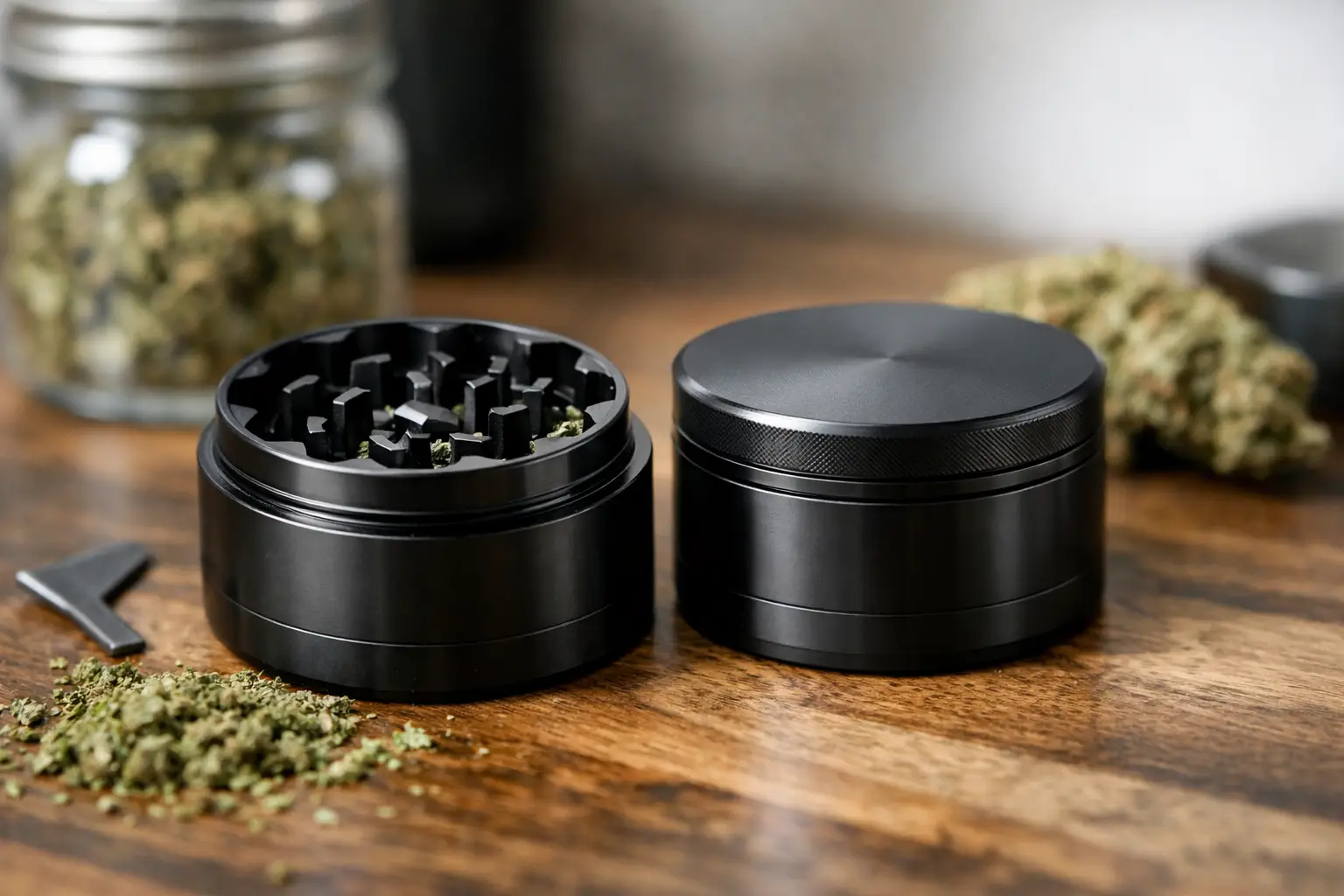
A grinder should not be the weak point in your setup. Yet cheap threaded models routinely prove why people replace grinders: lids cross-thread, chambers bind with residue, teeth dull, and aluminum flakes or paint wear into the places that touch your herb. This threadless herb grinder review looks at what changes when the grinder is engineered as a serious, long-term tool rather than a disposable accessory.
The short answer is that threadless construction solves one of the most common grinder failures without asking you to sacrifice a secure closure. A properly machined magnetic lid opens cleanly, closes with confidence, and eliminates the gritty twisting motion that turns a threaded grinder into a problem over time. But the best threadless grinder is more than a magnet. The real performance comes down to machining tolerances, tooth geometry, material, chamber layout, and how the entire unit is built.
Threadless Herb Grinder Review: What Makes It Different
A traditional threaded grinder relies on metal threads to join its pieces. When new, that design can feel solid. After repeated use, fine herb particles and sticky resin collect in the thread channels. The lid begins to drag, the parts can misalign, and cleaning becomes a chore. If the threads are shallow, poorly cut, or made from soft material, cross-threading can permanently damage the grinder.
A threadless grinder replaces the twist-on lid with a precision-fit magnetic closure. Instead of lining up threads and turning several times, you lift the lid, load your flower, and place it back on top. The experience is faster, cleaner, and far less likely to fight you when your hands are busy or the grinder has seen heavy use.
That convenience only matters if the closure is secure. Weak magnets can make a lid feel loose in a pocket or bag. Strong magnets, paired with a properly machined mating surface, hold the lid firmly while keeping access effortless. This is the difference between a novelty feature and an actual upgrade.
The Real Test Is in the Cut
The main job of any herb grinder is simple: turn dense, sticky flower into an even, usable consistency. Getting that result consistently is not simple at all.
Well-designed teeth should grab material, guide it through the cutting path, and break it down without pulverizing it into dust. Teeth that are too blunt tend to mash herb. Teeth that are too aggressive can create an overly fine grind, especially with dry flower. A quality CNC-machined grinder uses deliberately shaped teeth and a controlled tooth pattern to process herb evenly across the full surface of the chamber.
Consistency affects the rest of the session. Evenly ground flower packs more predictably, burns more evenly, and is easier to portion into a bowl, paper, cone, or vaporizer. A lumpy grind can create air pockets and uneven burn. Powdery material can pull through certain pipes or make a roll feel tighter than intended.
The best texture still depends on how you consume. Someone loading a vaporizer may prefer a medium-to-fine result. Someone rolling larger joints may want a fluffy medium grind that maintains airflow. A grinder cannot make every strain identical, but it should process the flower without forcing you to grind repeatedly, shake endlessly, or pick out half-cut chunks by hand.
Why CNC Machining Matters More Than Marketing
Many grinders look premium in a product photo. The differences appear after the first few weeks of real use. A grinder with loose tolerances can wobble, scrape, or leave uneven gaps between parts. A grinder made from lower-grade material may dent, wear, or develop rough edges. Decorative finishes can also hide a mediocre base design.
CNC machining gives a manufacturer direct control over the grinder’s dimensions, fit, and repeatability. When the teeth, chambers, and lid are machined accurately, the grinder feels deliberate in the hand. The pieces seat properly. The rotation stays smooth. The finished tool remains dependable long after the initial new-product feel is gone.
Material matters just as much. 6061-T6 aluminum is a proven choice for premium grinders because it balances strength, weight, and corrosion resistance. It is substantially more serious than the thin, mystery-metal grinders common at smoke shop counters and online marketplaces. A solid aluminum body also gives the grinder enough mass to feel stable without becoming a brick in your pocket.
Tahoe Grinder Co machines its grinders in-house in the USA, which matters because manufacturing control does not stop at a design file. It extends through machining, finishing, assembly, inspection, and fulfillment. That level of control is how a brand can stand behind tight tolerances and a lifetime warranty instead of treating a grinder as a low-cost, replaceable item.
Choosing Between 2-Piece, 3-Piece, and 4-Piece Designs
Threadless construction can work across multiple grinder configurations, so the right choice depends on how you prefer to prepare and collect herb.
A 2-piece grinder is the most direct option. It grinds and dispenses from the same chamber, making it compact, quick to empty, and easy to clean. It is a strong choice for users who want fresh ground flower on demand and do not need storage or separation.
A 3-piece grinder adds a lower storage chamber. The ground herb falls below the teeth instead of remaining in the grinding area, giving you a cleaner way to grind a larger amount and access it later. This design suits people who regularly prepare more than one session at a time.
A 4-piece grinder adds a fine screen and a bottom collection chamber for kief. For some consumers, that extra function is a major benefit. For others, especially users who prefer the simplest possible cleaning routine, a 2-piece or 3-piece model makes more sense. More components add versatility, but they also add surfaces that eventually need attention.
Size is another practical decision. Compact grinders travel well and work for smaller personal sessions. Larger models provide more cutting surface, hold more flower, and make light work of dense buds. An oversized 90mm grinder is not subtle, but it is built for users who are tired of doing multiple small loads in a cramped chamber.
Where Threadless Designs Have Trade-Offs
No honest review should pretend that every feature is perfect for every buyer. Threadless magnetic lids are exceptionally convenient, but they are not a substitute for secure storage practices. If you carry a grinder loose alongside keys, coins, and other gear, any grinder can take abuse. Keep it in a clean, protected spot.
Magnetic designs also depend on quality execution. A poorly designed threadless grinder may use magnets as a shortcut while ignoring fit, tooth performance, and material quality. That is why the word “threadless” alone should not decide the purchase. Look at the full build: CNC-machined construction, strong aluminum, precise component fit, thoughtful chamber design, and a warranty that has real weight behind it.
There is also a price difference. A precision-machined grinder costs more than a generic cast-metal unit because it takes more material, more time, and more controlled production to make correctly. The question is whether buying a cheap grinder several times is actually less expensive than buying one serious grinder once.
What to Look for Before You Buy
Start with the way you actually use cannabis, not the biggest list of features. If you want a fast, portable daily tool, a compact threadless 2-piece may be the right move. If you like to keep ground flower ready for later, consider a 3-piece. If kief collection is part of your routine, a 4-piece earns its place.
Then inspect the details that determine whether the grinder will stay enjoyable to use. The lid should close confidently. The teeth should be cleanly machined, not rough or stamped-looking. The grinder should feel substantial, with no rattling or inconsistent contact between pieces. Most importantly, buy from a manufacturer willing to stand behind the tool after the sale.
A great grinder fades into the background because it works every time. Choose one with the build quality to stay smooth, sharp, and dependable through years of flower, not just a few impressive turns out of the box.